Non-Reductionist Philosophy: Understanding the Quadrants 
The Quadrants framework in Non-Reductionist Philosophy (NRP) represents a sophisticated method for understanding reality through four irreducible ontological zones—distinct aspects of reality that cannot be collapsed into one another. This system goes far beyond simple perspective-taking, offering a comprehensive map for navigating complexity while avoiding the reductionist tendencies that plague most philosophical frameworks.
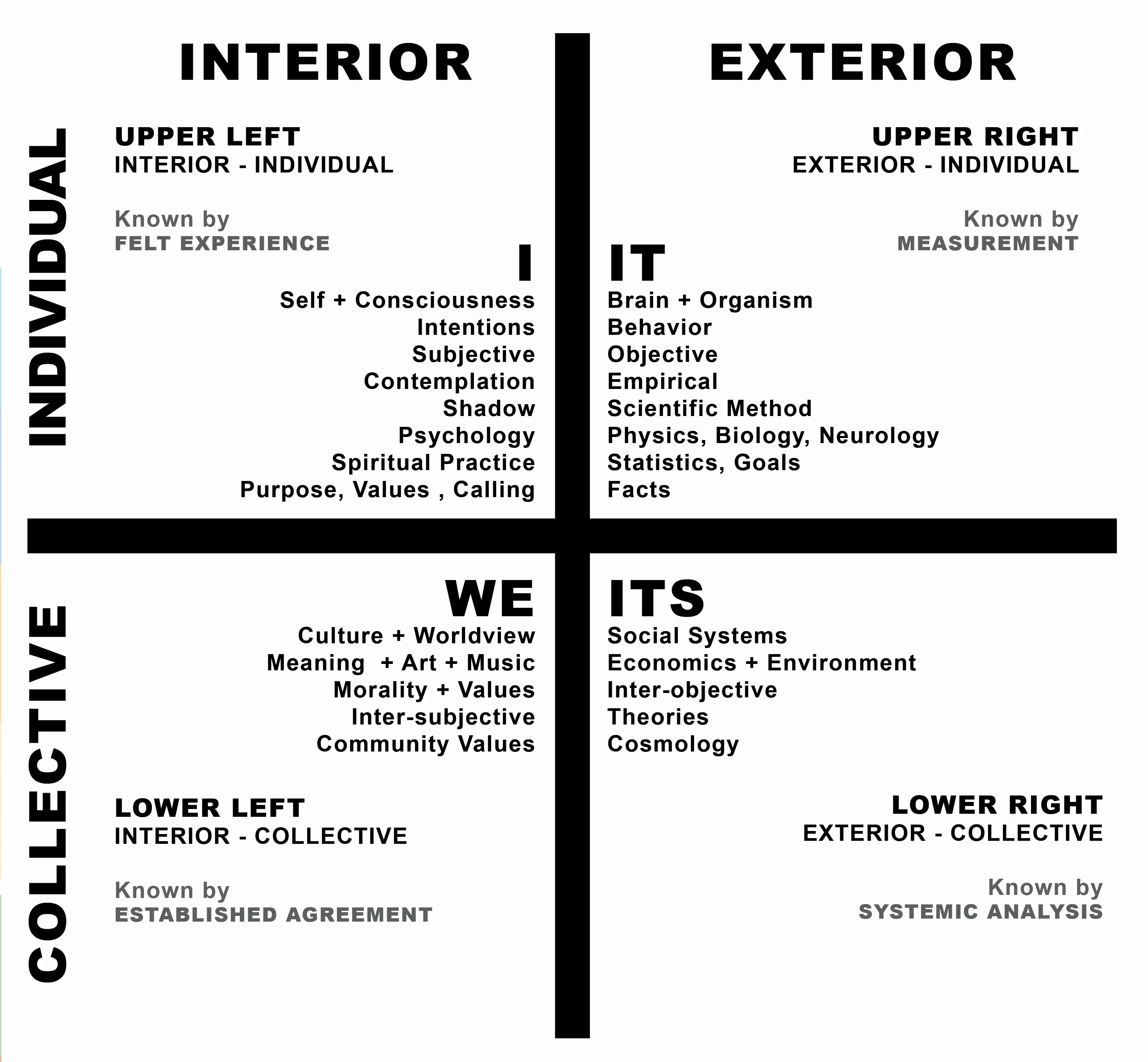
The Four Ontological Zones
Upper Left: Subjective (Interior Individual)
The subjective quadrant encompasses first-person experience, psychology, meaning, awareness, and intention. This domain includes spiritual practices, consciousness, values, purpose, and personal calling. It’s the realm of “I” language—what you feel, value, and intend. Traditional religious perspectives and red developmental stages often emphasize this quadrant, particularly through appeals to personal experience and testimony.
The primary way of knowing in this quadrant is through phenomenology—direct felt experience and subjective reports. While these reports are considered the least reliable in terms of external validation, they represent the authoritative source for understanding personal experience.
Upper Right: Objective (Exterior Individual)
The objective quadrant represents measurable phenomena, biology, physics, behavior, and observable facts. This is the domain of “it” language—what is empirical and objective. Modern rational perspectives typically focus heavily on this quadrant, sometimes to the point of reductionism, denying the existence of anything that cannot be measured or touched.
Knowledge in this quadrant is gained through the scientific method—measurement, falsifiability, and peer review. This includes physics, biology, neurology, and statistics, providing facts known through systematic observation and testing.
Lower Left: Intersubjective (Interior Collective)
The intersubjective quadrant encompasses culture, values, shared worldviews, language, and symbolic systems. This is the “we” space—what groups collectively agree upon. Examples include dictionary definitions, money’s value, social rules, laws, and prices, all of which function through collective agreement.
The primary methodology here is hermeneutics—the interpretation of shared meaning. Postmodern green perspectives often emphasize this quadrant, focusing on cultural relativism and shared meaning-making.
Lower Right: Interobjective (Exterior Collective)
The interobjective quadrant involves systems, structures, technology, economies, and institutions. This represents the “its” plural—social systems, economics, environments, and theories. Unlike the upper right’s focus on individual facts, this quadrant deals with systems analysis and theories that integrate multiple data points.
Knowledge is gained through systems theory—understanding how parts work within larger structures. This includes cosmology, economic theories, and systemic analysis of complex relationships.
Beyond Simple Perspective-Taking
A critical insight from NRP is that the quadrants are not merely perspectives—they represent actual ontological zones or aspects of reality. While you can take first-person, second-person, and third-person perspectives on things, the quadrants describe irreducible domains of reality itself, not just different ways of looking at the same thing.
Most people make the error of treating these as simple perspectives or trying to collapse one quadrant into another. For instance, many believe only subjective and objective categories exist, forcing “the good” into the subjective realm because it’s not objective.
The Fifth Ontological Category: The Absolute
Beyond the four quadrants lies the Absolute—the territory of which all quadrants are merely maps. This represents the thing-in-itself, which exists but can only be approached through relative symbols and concepts. The quadrants provide our best relative maps of reality, but they remain incomplete representations of the underlying absolute territory.
This distinction prevents the common error of confusing facts (objective reality) with absolute truth. Facts exist within the objective quadrant, but the absolute encompasses what lies beyond our capacity for direct access.
Quadratic Zoom and Scale
One of NRP’s unique contributions is the concept of Quadratic Zoom—the recognition that quadrants scale fractally across different levels of analysis. These scales include:
-
Macro: Broad aspects of reality
-
Intermediate: Projects within categories like metaphysics, life practice, morality, or governance
-
Micro: Subcategories within projects
-
Nano: Raw data
This scaling prevents “quadratic scale vertigo”—the confusion that arises when thinking you’ve covered a quadrant at one level while actually operating within a sub-quadrant of another level. For example, personal shadow work might seem to address the collective interior but actually remains within individual practice.
Nested Quadratic Holons and Primacy
Nested Quadratic Holons (NQH) represent how quadrants relate to each other differently depending on context and topic. Unlike Integral Theory, which suggests equal emphasis on all quadrants, NRP recognizes that the primacy or relative importance of quadrants shifts based on the specific domain being examined.
For instance, in epistemology, the sequence follows: “I think, therefore I am” (starting with subjective experience), then establishing the existence of others (intersubjective), then collaborative measurement (objective), leading to shared reality (interobjective). However, in ontology, the sequence reverses: universe/energy (interobjective) creates systems, which generate life, from which consciousness and individuals emerge.
The Pyramid of Philosophical Primacy illustrates this principle by showing that philosophy must be done in proper sequence: epistemology (how we know) grounds ontology (what exists), which informs morality (what’s good), which guides aesthetics (what’s beautiful). Starting from cosmology or identity creates distortions throughout the entire system.
The 4P4Z Framework
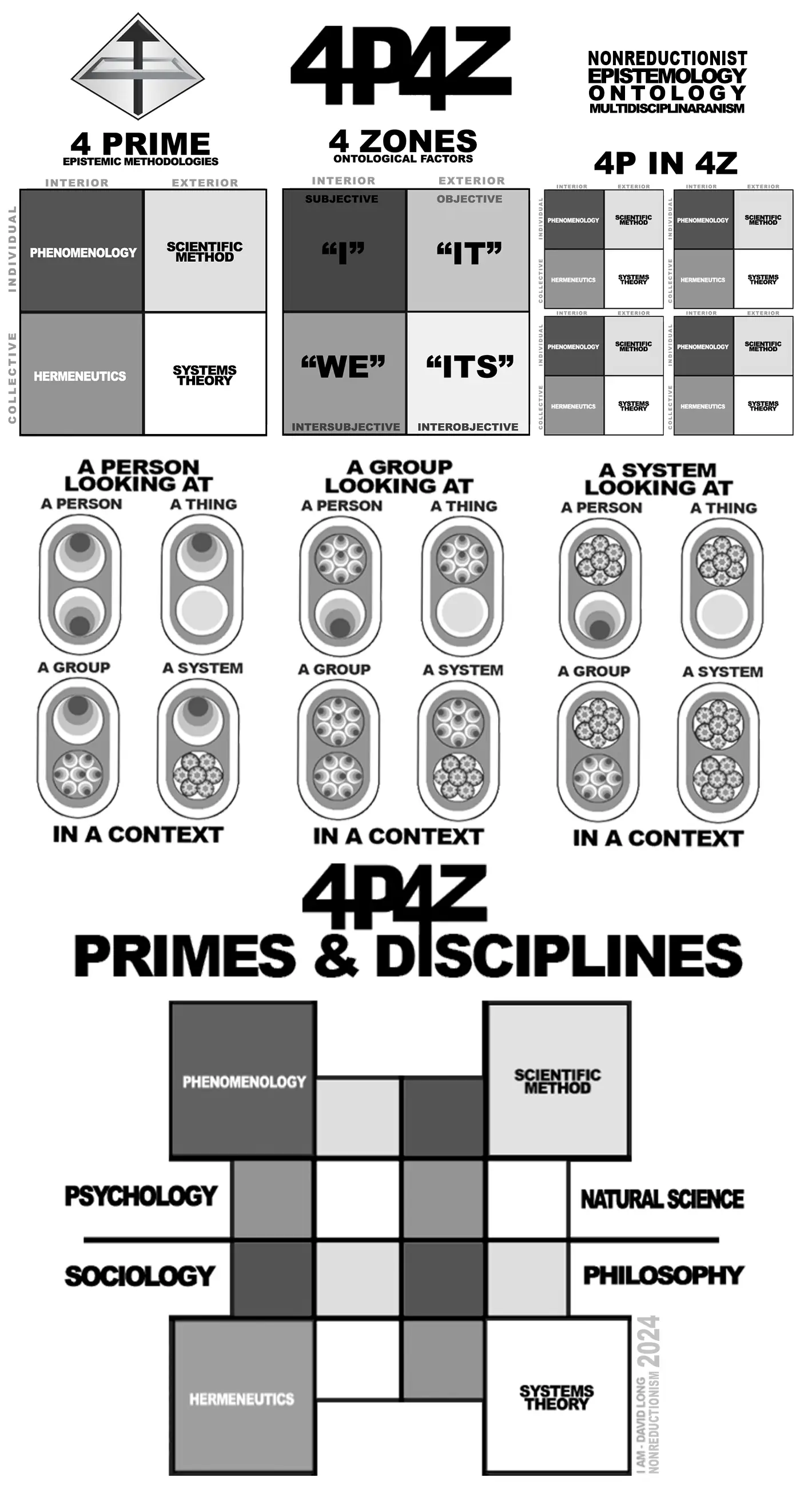
Four Primes in Four Zones (4P4Z) represents the metaphysical backbone of NRP. It maps four prime epistemological methodologies onto the four ontological zones:
-
Phenomenology (subjective reports) → Upper Left
-
Scientific Method (falsifiability/peer review) → Upper Right
-
Hermeneutics (interpretation of shared meaning) → Lower Left
-
Systems Theory (parts within larger structures) → Lower Right
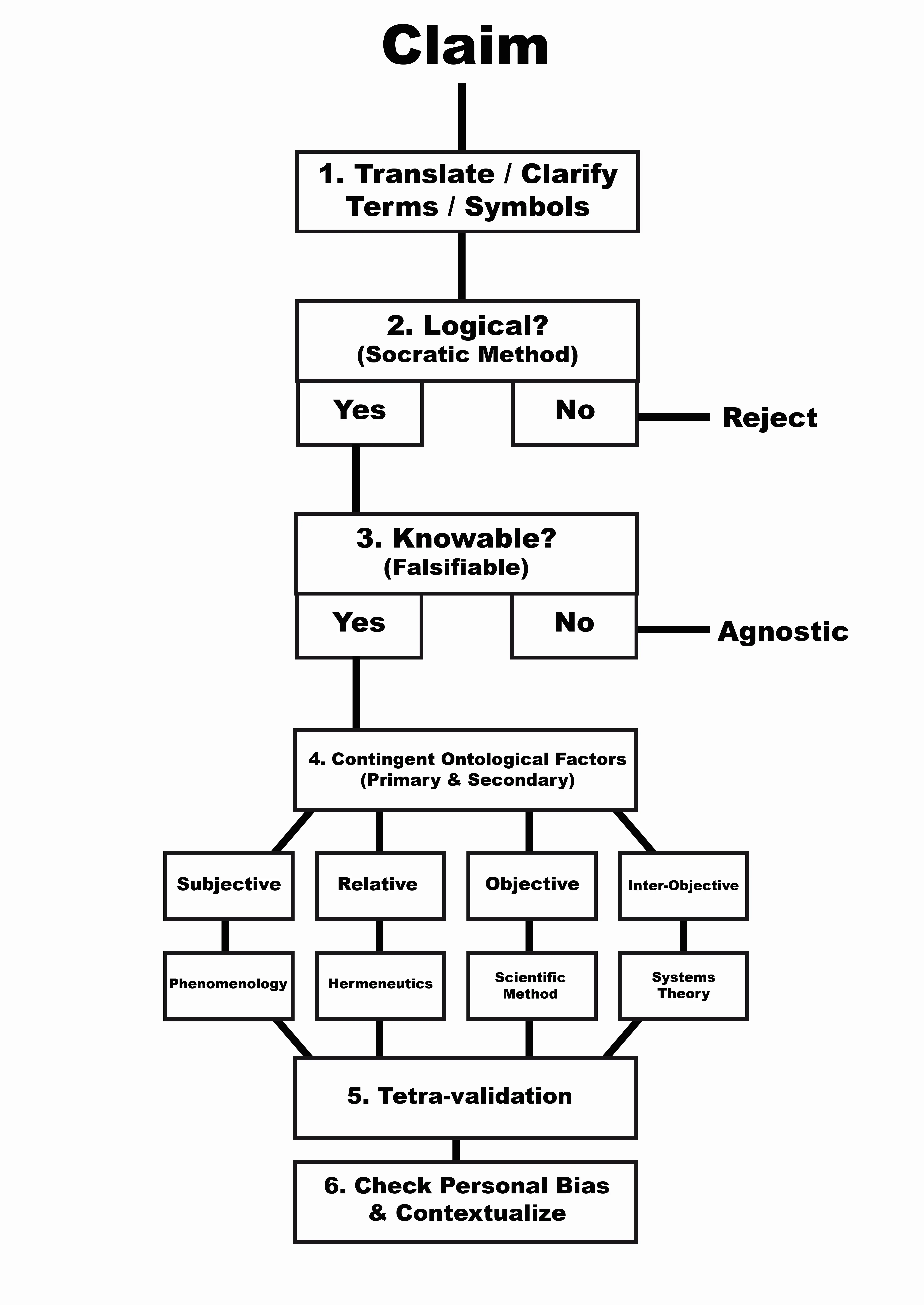
This framework introduces Contingent Ontological Factors—the recognition that what exists and counts as relevant depends on what’s being examined, who’s examining it, and the context. Cross-Quadrant Validation (tetra-validation) prevents bias by checking conclusions against all four zones rather than relying solely on one quadrant’s primary methodology.
Practical Applications
Basic Usage: The Checklist Approach
The most fundamental application treats quadrants as a comprehensive checklist for any project or decision. For example, when moving houses:
-
Upper Right: Practical tasks (boxes, cleaning, moving van)
-
Upper Left: Emotional processing (feelings about the move)
-
Lower Left: Relationship considerations (goodbye parties, new community connections)
-
Lower Right: Strategic planning (how this fits life goals, pros/cons analysis)
Advanced Applications
More sophisticated usage involves understanding quadrants within quadrants across different scales and recognizing appropriate primacy for specific contexts. This includes applications in:
-
Morality: Nested relationship between virtue ethics, deontology, consequentialism, and utilitarianism
-
Religion: Four functions including mystical, cosmological, social, and pedagogical aspects
-
Politics: Progressive/conservative and agentic/communal dimensions
-
Business: Holistic organizational design addressing all quadrants
Advantages Over Binary Thinking
The quadrants framework provides a sophisticated alternative to simplistic binary thinking that dominates much contemporary discourse. Instead of reducing complex issues to either/or positions (liberal vs. conservative, individual vs. collective, nature vs. nurture), quadrants allow for both/and integration that honors multiple valid perspectives while maintaining clear distinctions.
This prevents the conflation errors common in binary thinking, such as Jordan Peterson’s reduction of “woman equals chaos” rather than recognizing masculine and feminine expressions across all quadrants.
Integration Without Reduction
The genius of the quadrants framework lies in its ability to integrate knowledge without reducing it. Rather than collapsing different domains into one another, it maintains the integrity of each zone while showing how they interconnect. This creates what NRP calls “coherence as care”—bringing together complexity without flattening it into oversimplified models.
This approach enables translation between different developmental stages, worldviews, and disciplines while preserving the unique contributions of each domain. It provides the tools for navigating our fragmented world with both clarity and compassion, supporting conscious development at individual and collective levels.
The quadrants framework thus serves as both a practical tool for daily decision-making and a sophisticated philosophical map for understanding the full complexity of reality without losing ourselves in reductionist oversimplification.
— The above was based on a Patreon deep dive video by David Long and summarised by AI.
The Four Primes: Fundamental Methodological Approaches
1. Phenomenology — Subjective Reports
Phenomenology is the systematic study of consciousness and experience as it is lived and experienced from the first-person perspective. This approach focuses on subjective reports — the direct, lived experiences that individuals have of phenomena as they appear to consciousness, without making assumptions about their external reality.
The phenomenological method employs several key techniques. Bracketing involves suspending judgment about the external world to focus purely on how experiences appear to consciousness. Phenomenological reduction strips away cultural assumptions and preconceptions to reach the essential structures of experience. The method emphasizes intentionality — the fact that consciousness is always consciousness of something, always directed toward objects of awareness.
Phenomenology differs fundamentally from psychological or neuroscientific approaches because it studies experience as experienced, not as explained by external theories. For example, when studying pain, phenomenology examines the qualitative, lived experience of pain — its burning, stabbing, or aching qualities as felt by the person — rather than the neural pathways or chemical processes involved. This approach provides access to the “what it’s like” dimension of experience that cannot be captured through external observation alone.
In practical applications, phenomenology proves invaluable in healthcare settings where understanding patient experiences enhances treatment approaches. It also contributes significantly to consciousness studies, providing detailed descriptions of various states of awareness that inform both philosophy and cognitive science.
2. The Scientific Method — Falsifiability and Peer Review
The Scientific Method represents the systematic approach to understanding the natural world through empirical observation, hypothesis testing, and rigorous validation processes. This method operates on two fundamental pillars: falsifiability and peer review.
Falsifiability, developed by philosopher Karl Popper, serves as the cornerstone for distinguishing scientific theories from non-scientific claims. A theory is falsifiable if it makes specific predictions that could potentially be proven wrong through empirical testing. For example, the hypothesis “all swans are white” is falsifiable because observing a single black swan would definitively disprove it. This principle ensures that scientific theories remain testable and open to revision rather than becoming unfalsifiable dogma.
Peer review functions as the quality control mechanism of science, involving expert evaluation of research by qualified specialists in the relevant field. This process serves multiple functions: ensuring methodological rigor, verifying accuracy of data and conclusions, identifying potential problems or biases, and building trust within the scientific community. The peer review process has evolved from simple editorial oversight to a complex system that may include single-blind, double-blind, or open review formats.
The scientific method follows a systematic process: observation and question formulation, hypothesis development, experimental design with controls, data collection and statistical analysis, peer review and publication, and independent replication. This iterative process ensures that scientific knowledge remains provisional and self-correcting, constantly refined through new evidence and testing.
3. Hermeneutics — Interpretation of Shared Meaning
Hermeneutics is the theory and methodology of interpretation, particularly focused on understanding shared meanings, cultural contexts, and the ways humans create and communicate meaning collectively. Unlike phenomenology’s focus on individual experience, hermeneutics examines how meaning emerges through interpretation of shared cultural phenomena.
The hermeneutical approach operates through several key concepts. The hermeneutical circle describes the iterative process between understanding parts and wholes — we understand individual elements through their context in larger wholes, while simultaneously understanding wholes through their constituent parts. Fusion of horizons, developed by Hans-Georg Gadamer, refers to the process whereby different perspectives or cultural viewpoints merge to create new understanding.
Prejudgment or pre-understanding recognizes that all interpretation begins from our existing knowledge, cultural background, and historical situation. Rather than being a limitation, this situatedness provides the foundation that makes understanding possible. The hermeneutical method emphasizes dialogue as the primary means through which understanding emerges — through conversation and exchange, new meanings are created that transcend individual perspectives.
Hermeneutics proves essential for understanding cultural phenomena, language, literature, law, and any domain where meaning is constructed socially. For example, interpreting a historical text requires understanding not only the literal words but also the cultural context, historical situation, and intended audience of the original author. This method reveals how shared meanings shape individual understanding and how cultural contexts influence interpretation.
4. Systems Theory — How Parts Work Within Larger Structures
Systems Theory examines how individual components interact and organize to create complex wholes with emergent properties that cannot be understood by analyzing parts in isolation. This approach recognizes that “the whole is greater than the sum of its parts” — complex systems exhibit behaviors and characteristics that emerge from the relationships and interactions between components.
Systems theory operates on several fundamental principles. Holism requires understanding systems as integrated wholes rather than collections of separate parts. Emergence refers to new properties that arise from system organization — consciousness emerging from neural networks, or flocking behavior emerging from simple rules followed by individual birds. Interconnectedness emphasizes that all system components influence each other through complex webs of relationships.
Hierarchy recognizes that systems exist at multiple levels — each system contains subsystems and exists within larger supersystems. For example, cells exist within organs, organs within organisms, organisms within ecosystems. Feedback loops describe how systems self-regulate through information flows that influence system behavior.
Systems theory transcends traditional disciplinary boundaries, applying equally to biological organisms, social organizations, economic markets, technological networks, and ecological systems. This approach proves particularly valuable for understanding complex challenges that cannot be solved by focusing on individual components alone. For instance, understanding climate change requires systems thinking that encompasses atmospheric chemistry, ocean currents, biological processes, and human social and economic systems.
The Four Zones (Quadrants): Fundamental Perspectives on Reality
The Four Zones represent distinct perspectives through which any phenomenon can be examined, organized along two fundamental axes: Individual vs. Collective and Interior vs. Exterior. These zones ensure comprehensive analysis by preventing the reduction of complex phenomena to single perspectives.
1. Inner Individual (Subjective Experience)
The Inner Individual zone encompasses the “I” space of subjective experience — the first-person, interior dimension of individual consciousness. This zone includes thoughts, emotions, intentions, perceptions, memories, dreams, spiritual states, and the entire spectrum of individual awareness.
This zone represents the domain of personal, subjective experience that cannot be directly observed by others. It includes both conscious and unconscious psychological processes, personal values and beliefs, aesthetic experiences, and the qualitative aspects of mental states. Examples include the experience of falling in love, the felt sense of making a moral decision, the qualitative experience of seeing the color red, or the subjective state during meditation.
The Inner Individual zone is typically accessed through introspection, self-reflection, meditation, therapy, and phenomenological investigation. This zone cannot be measured directly through external instruments but can be explored through first-person methodologies and subjective reporting.
2. Inner Collective (Relative Cultural Meaning)
The Inner Collective zone represents the “We” space of shared meanings, cultural values, worldviews, and intersubjective understanding. This zone encompasses the collective interior dimension — the shared consciousness that emerges when groups of individuals create common meanings, languages, and cultural systems.
This zone includes language systems, cultural values, religious and spiritual beliefs, social norms, collective myths and stories, shared symbols and meanings, and the worldviews that shape how cultures understand reality. Examples include the shared understanding of democratic values in a society, the cultural meaning of marriage ceremonies, the collective worldview embedded in a language, or the shared spiritual practices of a religious community.
The Inner Collective zone varies significantly between different cultures, historical periods, and social groups. It forms the cultural context within which individual meaning-making occurs and shapes how individuals interpret their experiences. This zone is studied through hermeneutical methods, cultural anthropology, linguistics, and the interpretation of shared symbolic systems.
3. Outer Individual (Objective Things)
The Outer Individual zone encompasses the “It” space of objective, observable phenomena related to individuals. This zone includes the physical body, brain states, behavior patterns, and any aspect of individuals that can be measured, observed, or studied through third-person, scientific methods.
This zone covers biological processes, neurological activity, observable behaviors, physiological responses, physical health indicators, and measurable individual characteristics. Examples include brain scans showing neural activity, observable behavior patterns, hormonal levels, genetic markers, reaction times in psychological experiments, or measurable changes in physical health.
The Outer Individual zone follows physical laws and empirical patterns that can be studied through scientific methodology. This zone provides the objective, material foundation for individual existence and can be measured using scientific instruments and experimental methods. It represents the domain where scientific method and empirical observation prove most directly applicable.
4. Outer Collective (Inter-objective Systems)
The Outer Collective zone represents the “Its” space of collective, external phenomena — the objective dimensions of social, technological, and environmental systems. This zone encompasses the structural, institutional, and systemic aspects of collective existence that can be observed and measured.
This zone includes social institutions, economic systems, technological networks, government structures, legal systems, environmental systems, organizational hierarchies, and infrastructure. Examples include the structure of democratic institutions, economic markets and trade systems, technological networks like the internet, ecological systems, transportation networks, or the organizational structure of corporations.
The Outer Collective zone exhibits emergent properties that arise from the interactions of multiple components and can be studied through systems analysis, social science research, and empirical observation. This zone often displays complex, non-linear behaviors where small changes can have large systemic effects. It represents the domain where systems theory and structural analysis prove most applicable.
Reasonable Limits of Knowledge
The concept of Reasonable Limits of Knowledge provides a sophisticated framework for understanding what can be known, what might be knowable, and what remains fundamentally unknowable. This framework acknowledges that human knowledge has inherent boundaries while avoiding both naive overconfidence and paralyzing skepticism.
Reasonable Limits of Knowledge: A hierarchical model showing what can be known, what might be knowable, and what remains unknowable
Hierarchy of Knowability
Level 1: Direct Access (Known) At the foundational level lie phenomena that humans can know with direct access. Subjective Facts include immediate personal experiences — one’s own thoughts, feelings, and consciousness states that are directly accessible through first-person experience. Inter-Subjective Facts encompass shared cultural meanings, language systems, and collectively agreed-upon symbols that communities create and maintain. Objective Facts include established scientific knowledge, empirical data, and phenomena that can be measured and verified through scientific methods.
Level 2: Testable Theories (Knowable but Unknown) This level includes phenomena that are potentially knowable but not yet known. Objective phenomena not yet measured represent the frontier of scientific discovery — aspects of the physical world that exist but haven’t been studied or understood yet. Personal unconscious elements include psychological processes, memories, or motivations that could potentially be discovered through therapy, reflection, or psychological investigation. Others’ experiences that can be partially accessed through communication, empathy, and hermeneutical understanding also fall in this category.
Level 3: Theoretically Unknowable (Agnostic/Hypothesis) This level encompasses phenomena that may be inherently beyond human cognitive access. Others’ subjective experiences beyond direct access acknowledges that we can never fully know another person’s inner experience with the same directness we know our own. Complex system behaviors that exceed our computational or cognitive capacity represent another boundary — some systems may be too complex for complete human understanding. Future states that are inherently unpredictable due to chaotic dynamics or quantum uncertainty also belong here.
Level 4: Fundamentally Unknowable (Hard Agnostic) At the highest level lie questions that transcend the limits of human cognition entirely. Ultimate sources or origins beyond empirical access — such as what exists “before” the Big Bang or “outside” the universe — may be fundamentally unknowable. Absolute truths about the nature of reality itself represent another category of hard limits. These questions may transcend the very structure of human cognition and language.
Epistemological Flow Chart: A step-by-step process for evaluating knowledge claims using the 4P4Z framework
Epistemological Implications
This framework promotes epistemic humility — the recognition that knowledge has inherent limits and that acknowledging these limits is a sign of wisdom rather than weakness. It supports methodological pluralism by demonstrating that different types of knowledge require different methodological approaches. The framework emphasizes contextual knowing — all knowledge is situated within particular perspectives and cultural contexts.
The approach maintains that provisional truth characterizes scientific knowledge — our best current understanding that remains open to revision based on new evidence. Most importantly, it demonstrates that the four primes work together complementarily, each providing access to different aspects of reality that cannot be reduced to any single approach.
Integration and Practical Application
The 4P4Z framework operates as an integrated system where the Four Primes provide methodological approaches while the Four Zones ensure comprehensive perspective-taking. Phenomenology maps most directly onto the Inner Individual zone, providing methods for exploring subjective experience. Scientific Method aligns with the Outer Individual zone, offering tools for studying objective, measurable phenomena. Hermeneutics corresponds to the Inner Collective zone, providing interpretive methods for understanding shared cultural meanings. Systems Theory connects with the Outer Collective zone, offering frameworks for analyzing complex social and environmental systems.
However, the framework’s sophistication lies in recognizing that any complete analysis requires tetra-validation — examining phenomena from all four perspectives. For example, understanding mental health requires phenomenological investigation of subjective experience, scientific study of brain states and behaviors, hermeneutical understanding of cultural meanings of mental health, and systems analysis of healthcare institutions and social support networks.
Non-Reductionist Philosophy: 4L4Z, 4I4Z, 4M4Z, Modes/Roles, and Primacy
Overview of the Advanced NRP Frameworks
Based on the documents provided, Non-Reductionist Philosophy (NRP) extends beyond the basic quadrants to include several advanced frameworks that apply quadrant logic to specific domains. These frameworks represent what NRP calls “quadrants within quadrants” or specialized applications of the four-zone ontological model.
4L4Z - Four Life Practices in Four Zones (Life Practice/Spirituality)
Definition
4L4Z refers to Non-Reductionist Life Practice (NRLP) - a comprehensive approach to spiritual practice that maps four types of practices across all four quadrants. This framework represents the upper left quadrant of NRP but expanded into its own four-quadrant system.
The Four Life Practice Areas
According to the documents, the four areas are:
-
State Training (Upper Left) - Working with temporary conditions of consciousness
-
Self-Mastery (Upper Right) - Developing personal discipline and skills
-
Study/Philosophy (Lower Right) - Engaging with knowledge systems and frameworks
-
Social Work/Community Service (Lower Left) - Contributing to collective well-being
Comprehensive Approach
The NRLP has “32 factors at play” because it includes “quadrants within quadrants within quadrants, and then the upper left quadrants within quadrants of every other quadrant”. This creates a far more nuanced approach than typical spiritual practices that might only focus on meditation or personal development.
4M4Z - Four Moralities in Four Zones
Definition
4M4Z represents four different moral systems mapped across the four quadrants, showing how different ethical approaches relate to different ontological domains.
The Four Moral Systems
The framework includes:
-
Virtue Ethics - Character-based morality
-
Deontology - Duty-based ethics focused on rules and roles
-
Consequentialism - Results-based moral evaluation
-
Utilitarianism - Greatest good for greatest number
Nested Relationship
Importantly, these aren’t competing systems but are nested hierarchically. As explained: “Deontology is inside utilitarianism and is based on someone’s role. There’s only 1 moral system. It’s not like they conflict with each other”. The role-based duties (deontology) serve the greater utilitarian framework.
Practical Application
The trolley problem examples in the documents illustrate how different roles (trolley driver, citizen, doctor) involve different moral standards, but all serve utilitarian ends. A doctor’s duty not to harm patients in the waiting room serves the greater good of maintaining trust in medical institutions.
4I4Z - Four Ideologies in Four Zones (Politics)
Definition
4I4Z maps four political ideologies across the quadrant system, showing how different political orientations correspond to different ontological domains.
The Framework
The documents mention this includes mappings of:
-
Progressive vs Conservative (one axis)
-
Agentic vs Communal (another axis, where agentic means individualistic and communal means collective)
Color-Coded Development
The political quadrants also incorporate developmental levels (colors from Spiral Dynamics), showing how different stages of development express political orientations differently.
Modes/Roles - Conscious Living Framework
Definition
ModesRoles is described as “the newest Element” focused on “conscious living through a becoming self mastery practice”. It emphasizes being “intentional, skillful, and appropriate for the situation and our role within it”.
Key Features
-
Mode Flexibility - The ability to switch between different modes as situations require
-
Role Awareness - Understanding one’s position and responsibilities in different systems
-
Contextual Appropriateness - Matching response to situation and role
Skills Development
The framework focuses on developing “skills and postures we develop to engage with life intentionally” including “attention, willpower, focus, and our roles within systems”.
Primacy - The Hierarchical Relationship Framework
Definition
Primacy refers to understanding “how the quadrants relate to each other or are valued differently depending on the project”. This is fundamentally different from Integral Theory, which gives equal emphasis to all quadrants.
Nested Quadratic Holons (NQH)
This tool shows “how to properly nest domains of reality in relation to specific topics or projects”. It identifies “which aspects are more fundamental and how others must be nested within them depending on context.”
Key Examples
Philosophical Primacy
The Pyramid of Philosophical Primacy establishes that philosophy must be done in proper sequence:
-
Epistemology (how do you know?) comes first
-
Ontology (what is it?) builds on epistemology
-
Cosmology (where does it come from?) follows
-
Ethics/Morality is grounded in the above
As explained: “You have to ground everything in truth. What’s good doesn’t dictate what’s true. Too many people start from a cosmology first, instead of epistemology”.
Context-Dependent Primacy
Different projects require different primacy relationships:
-
For Epistemology: Interior to Exterior (I to IT) - starting with subjective certainty then building outward
-
For Ontology: Exterior to Interior (IT to I) - systems create individuals who develop interiority
-
Different goals/contexts give different primacy
Dictionary Definitions of Key Concepts
Epistemology
“The branch of philosophy that studies the nature, origin, and limits of human knowledge. Derived from the Greek words episteme (knowledge) and logos (reason/study), it explores fundamental questions such as ‘What is knowledge?’ ‘How do we acquire it?’ and ‘Can we truly know anything at all?‘”
Ontology
“The branch of metaphysics dealing with the nature of being. A set of concepts and categories in a subject area or domain that shows their properties and the relations between them”. It examines “the commonalities among all things and investigates their classification into basic types”.
Cosmology
“A branch of physics and metaphysics dealing with the nature of the universe, the cosmos… concerned with the study of the chronology of the universe”.
Deontology
“A normative ethical theory in philosophy that asserts the morality of an action is determined by its adherence to a set of rules and duties, rather than by its consequences or outcomes”. Key principles include:
-
Duty-Based Ethics - emphasizing moral obligations
-
Rules and Principles - actions judged by conformity to binding moral rules
-
Focus on Intent - the motivation behind action determines moral worth
-
Independence of Consequences - moral status separate from results
Holon
“A part of a larger whole whilst containing sub parts to it. E.g we are a holon, but also contain organs, etc.”. Something that is “simultaneously a part of a larger whole and has smaller sub-wholes within it”.
Primacy
As defined by Kant: “the prerogative of the interest of one insofar as the interests of others is subordinated to it”. In NRP context, it refers to the hierarchical ordering of quadrants based on the specific project or context.
Practical Applications and Importance
These advanced frameworks serve several crucial functions:
-
Prevents Reductionism - By mapping complexity across multiple dimensions rather than flattening to single approaches
-
Enables Integration - Shows how different systems (moral, political, spiritual) can work together rather than compete
-
Provides Developmental Guidance - The primacy principle prevents starting with the wrong foundations (like beginning ethics before establishing epistemology)
-
Supports Skillful Action - Modes/Roles framework enables appropriate response based on context and position
-
Creates Comprehensive Life Practice - 4L4Z provides holistic approach to development rather than narrow focus on single practices
These frameworks represent NRP’s attempt to create truly integral approaches that honor the complexity of human experience while providing practical guidance for development and action.
Conclusion
The 4P4Z framework provides a comprehensive meta-theoretical approach that transcends the limitations of reductionist thinking while maintaining rigorous standards for knowledge. By integrating four distinct methodological approaches with four fundamental perspectives on reality, this system offers a sophisticated toolkit for understanding complex phenomena without reducing them to single explanations. The framework’s acknowledgment of reasonable limits of knowledge promotes epistemic humility while avoiding both naive scientism and relativistic confusion. For AI systems and human practitioners alike, this framework offers a structured approach to comprehensive analysis that honors the complexity of reality while providing practical methodological guidance.