Comprehensive Guide to Developmental Lines and Multiple Intelligences for AI-Based Assessment Systems
Understanding human development requires a multidimensional approach that recognizes the complexity and diversity of human capacities. This comprehensive guide examines Howard Gardner’s theory of multiple intelligences alongside other developmental frameworks within non-reductionist philosophy, providing specific methodologies for AI systems to assess developmental levels across multiple domains. The integration of these frameworks offers a sophisticated lens for understanding how individuals develop different capacities at varying rates and to different degrees throughout their lives 123.
Howard Gardner’s Theory of Multiple Intelligences
Theoretical Foundation
Howard Gardner revolutionized the understanding of intelligence in 1983 with his groundbreaking work “Frames of Mind: The Theory of Multiple Intelligences” 12. Gardner challenged the traditional notion of a single, general intelligence factor (g-factor) by proposing that intelligence is not a monolithic capacity but rather a collection of distinct, relatively independent abilities 23. His theory defines intelligence as a “biopsychological potential to process information that can be activated in a cultural setting to solve problems or create products that are of value in a culture” 2.
Gardner developed eight specific criteria for identifying valid intelligences, including potential isolation by brain damage, evolutionary history, identifiable core operations, susceptibility to encoding in symbol systems, distinct developmental trajectories, existence of savants and prodigies, and support from experimental psychology 2. These rigorous criteria distinguish true intelligences from mere talents or abilities, providing a scientific foundation for the theory’s validity.
The Eight Core Intelligences
Gardner’s framework encompasses eight primary intelligences, each representing distinct cognitive capacities that develop independently 123:
Linguistic-Verbal Intelligence involves the masterful use of language for expression, communication, and understanding 2. Individuals with strong linguistic intelligence excel in writing, storytelling, verbal expression, and language learning. They demonstrate sophisticated vocabulary usage, effective rhetorical skills, and the ability to manipulate syntax, semantics, and phonology with precision.
Logical-Mathematical Intelligence encompasses the capacity to analyze problems logically, perform mathematical operations, and investigate issues scientifically 2. This intelligence involves abstract reasoning, pattern recognition, and the ability to understand underlying causal systems. Individuals strong in this area excel at developing equations, making calculations, and solving complex computational problems.
Spatial-Visual Intelligence represents the ability to perceive and manipulate visual-spatial information accurately 2. This includes visualization skills, spatial memory, artistic ability, and the capacity to recognize and transform visual patterns. Individuals with high spatial intelligence excel in navigation, architecture, graphic design, and three-dimensional thinking.
Bodily-Kinesthetic Intelligence involves using one’s body or parts of the body to solve problems or create products 2. This intelligence encompasses physical coordination, balance, dexterity, strength, and the mind-body connection necessary for skilled physical performance. Athletes, dancers, surgeons, and craftspeople typically demonstrate high levels of this intelligence.
Musical Intelligence encompasses the ability to perceive, discriminate, create, and express musical forms 2. This includes sensitivity to rhythm, pitch, melody, timbre, and musical structure. Individuals with musical intelligence can recognize musical patterns, compose music, and demonstrate sophisticated understanding of musical elements.
Interpersonal Intelligence represents the capacity to understand and interact effectively with others 2. This intelligence involves reading social cues, understanding motivations and intentions, communicating effectively, and building relationships. Individuals with strong interpersonal intelligence excel in leadership, teamwork, counseling, and social situations.
Intrapersonal Intelligence focuses on self-understanding and the effective use of self-knowledge 2. This includes self-awareness, emotional regulation, personal reflection, and the ability to understand one’s own motivations, strengths, and limitations. Individuals with high intrapersonal intelligence demonstrate independence, self-direction, and emotional maturity.
Naturalistic Intelligence involves the ability to recognize, categorize, and draw upon patterns in the natural environment 2. This intelligence includes sensitivity to flora, fauna, and natural phenomena, as well as the capacity to classify and understand natural systems. Biologists, environmentalists, and farmers typically demonstrate strong naturalistic intelligence.
Gardner has also proposed a ninth intelligence, Existential Intelligence, which involves the capacity to contemplate deeper questions about existence, meaning, and the human condition 12. While not yet fully validated according to his criteria, this intelligence represents the philosophical and spiritual dimensions of human cognition.
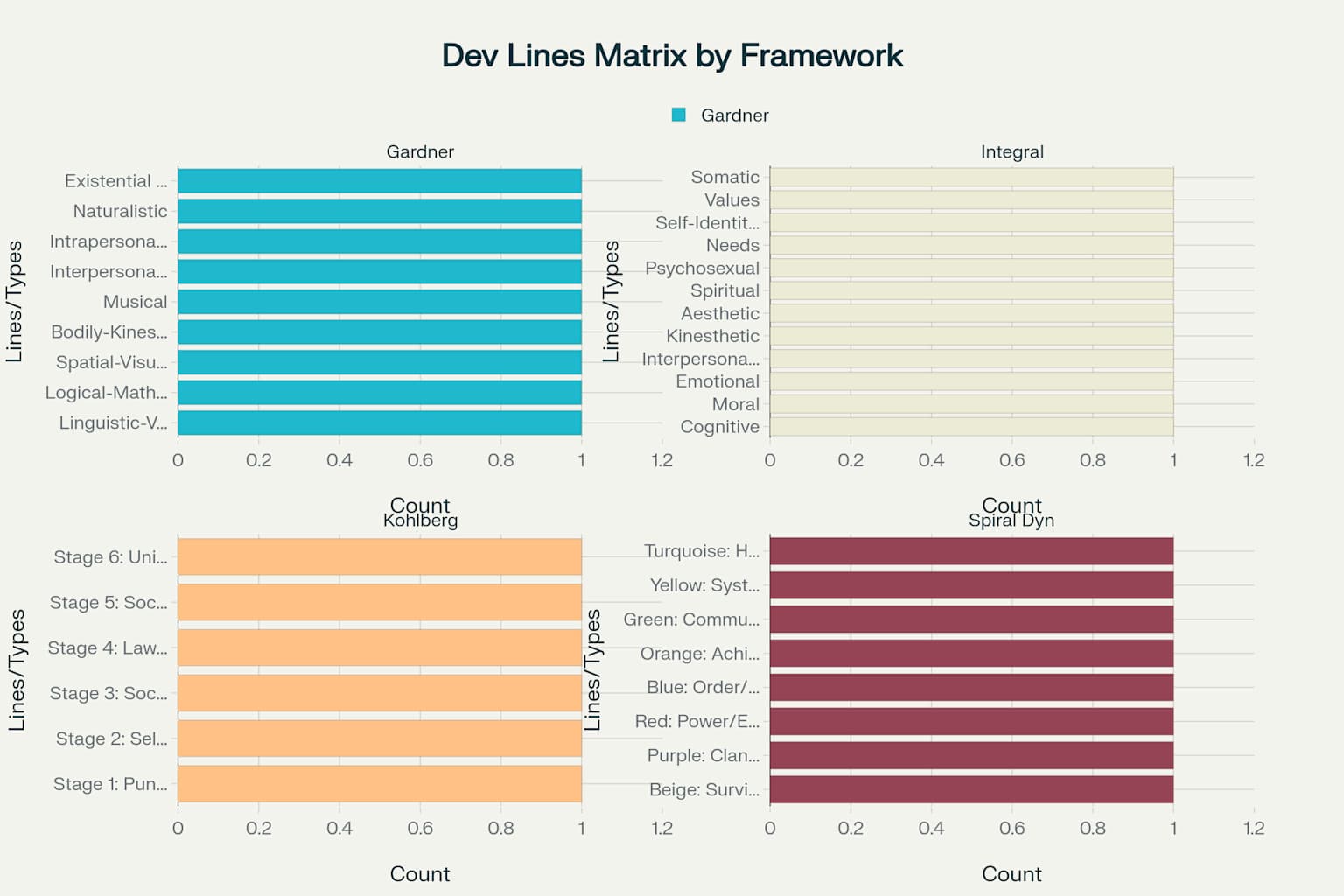
Comprehensive Matrix of Developmental Assessment Frameworks for AI Systems
Integral Theory’s Developmental Lines Framework
Ken Wilber’s Comprehensive Approach
Ken Wilber’s Integral Theory provides a comprehensive meta-framework that organizes human development across multiple dimensions 456. Within this framework, developmental lines represent distinct capacities that evolve through various stages of complexity and depth 45. Wilber has identified up to 24 different lines of development, each representing a specific area where growth and transformation occur 57.
The concept of developmental lines recognizes that human beings develop unevenly across different capacities 45. A person might be highly advanced in cognitive development while remaining relatively underdeveloped in emotional or interpersonal domains. This uneven development pattern is a fundamental characteristic of human growth and represents both the diversity and complexity of human potential.
Core Developmental Lines
Cognitive Line encompasses mental processing abilities, reasoning capacity, and abstract thinking skills 48. This line includes the development of logical reasoning, problem-solving abilities, and the capacity for increasingly complex mental operations. Assessment involves evaluating performance on cognitive tasks, reasoning assessments, and abstract thinking challenges.
Moral Line represents the evolution of ethical reasoning and understanding of right and wrong 48. This line follows patterns similar to Kohlberg’s stages of moral development, progressing from punishment-avoidance through conventional conformity to principled ethical reasoning. Assessment involves analyzing responses to moral dilemmas and ethical decision-making scenarios.
Emotional Line involves the development of emotional awareness, regulation, and expression 45. This includes the capacity to recognize, understand, and manage emotions effectively, as well as the ability to use emotional information in decision-making and relationships. Assessment requires evaluating emotional intelligence, regulatory strategies, and affective responses.
Interpersonal Line encompasses the ability to understand, relate to, and interact effectively with others 45. This line includes empathy, social skills, communication abilities, and the capacity for healthy relationships. Assessment involves analyzing social interactions, communication patterns, and relationship quality.
Spiritual Line represents the development of connection to transcendent dimensions of experience 49. This includes meaning-making, purpose, connection to the sacred, and experiences of unity or transcendence. Assessment requires analyzing spiritual practices, meaning-making narratives, and transcendent experiences.
Aesthetic Line involves the appreciation and creation of beauty, art, and creative expression 45. This includes artistic sensibility, creative abilities, and the capacity to perceive and create aesthetic experiences. Assessment involves evaluating artistic appreciation, creative output, and aesthetic sensitivity.
Kinesthetic Line encompasses physical coordination, body awareness, and motor skills development 45. This includes athletic abilities, physical coordination, and the integration of mind-body awareness. Assessment requires evaluating motor skills, physical coordination, and body awareness.
Non-Reductionist Philosophy and Enhanced Developmental Understanding
David Long’s Meta-Theoretical Framework
Non-Reductionist Philosophy, developed by David Long, represents a next-generation meta-theory that seeks to upgrade and integrate existing developmental frameworks 101112. This approach recognizes that complex human phenomena cannot be fully understood by reducing them to constituent parts, instead requiring holistic integration that honors both rational inquiry and meaningful narrative 11.
Long’s framework incorporates multiple factors of reality including ontological aspects, epistemic methodologies, developmental lines moving through stages, personality types, states of being, and modes of becoming 11. This comprehensive approach provides what he terms “holistic simplicity on the other side of complexity” that can be applied across every human discipline.
Sacred Naturalism and Developmental Assessment
Non-Reductionist Philosophy emphasizes “Sacred Naturalism,” which recognizes life and the natural world as sacred while maintaining scientific rationalism 11. This perspective views consciousness as an emergent property arising from the interplay of natural systems, biological processes, and social interactions, rather than as a fundamental ground of reality.
The framework emphasizes “becoming” over static “being,” advocating for dynamic engagement and continuous transformation 11. This active approach to development recognizes that spirituality and growth are ongoing processes rather than end-states, requiring continual learning, adaptation, and creative engagement with reality.
Integration Standards and Assessment Protocols
Non-Reductionist Philosophy provides consistent and coherent standards for integration that avoid both arbitrary combination and reductionist conflation 11. These standards ensure that developmental assessment maintains intellectual rigor while honoring the complexity and diversity of human experience.
The framework advocates for qualified leadership and structured learning pathways within developmental communities 11. This includes certification processes, educational programs, and accountability structures that support both individual growth and collective transformation.
Kohlberg’s Moral Development Framework
Stages of Moral Reasoning
Lawrence Kohlberg’s theory of moral development provides a crucial framework for understanding the evolution of ethical reasoning 131415. Kohlberg identified six stages of moral development organized into three levels: preconventional, conventional, and postconventional 131415.
Preconventional Level (Stages 1-2) focuses on external consequences and self-interest 1415. Stage 1 involves punishment and obedience orientation, where moral decisions are based on avoiding negative consequences. Stage 2 represents instrumental purpose orientation, where actions are guided by personal benefit and reciprocal exchanges.
Conventional Level (Stages 3-4) emphasizes social expectations and maintaining order 1415. Stage 3 involves good interpersonal relationships and social approval, where individuals seek to be perceived as “good” by conforming to social expectations. Stage 4 focuses on law and order, emphasizing duty, respect for authority, and maintaining social systems.
Postconventional Level (Stages 5-6) transcends conventional social expectations to embrace universal principles 1415. Stage 5 involves social contract and individual rights, recognizing democratic principles and the importance of protecting individual freedoms. Stage 6 represents universal ethical principles, where moral decisions are guided by self-chosen ethical principles that apply universally.
Spiral Dynamics Values Framework
Values-Based Developmental Levels
Spiral Dynamics, developed by Clare Graves and later expanded by Don Beck and Chris Cowan, provides a framework for understanding the evolution of value systems and worldviews 1617. This model describes how individuals and cultures develop through discrete levels of values consciousness, each emerging in response to life conditions and challenges.
First Tier Levels represent fundamental value systems that address survival, safety, power, order, achievement, and community 1617. These include Beige (survival), Purple (safety/tribal), Red (power/egocentric), Blue (order/purposeful), Orange (achievement/strategic), and Green (community/relativistic).
Second Tier Levels transcend the limitations of first tier thinking through systemic and integral perspectives 1617. Yellow (systemic/integrative) recognizes the validity and necessity of all previous levels while focusing on flexibility and natural flows. Turquoise (holistic/global) emphasizes global consciousness and the integration of all living systems.
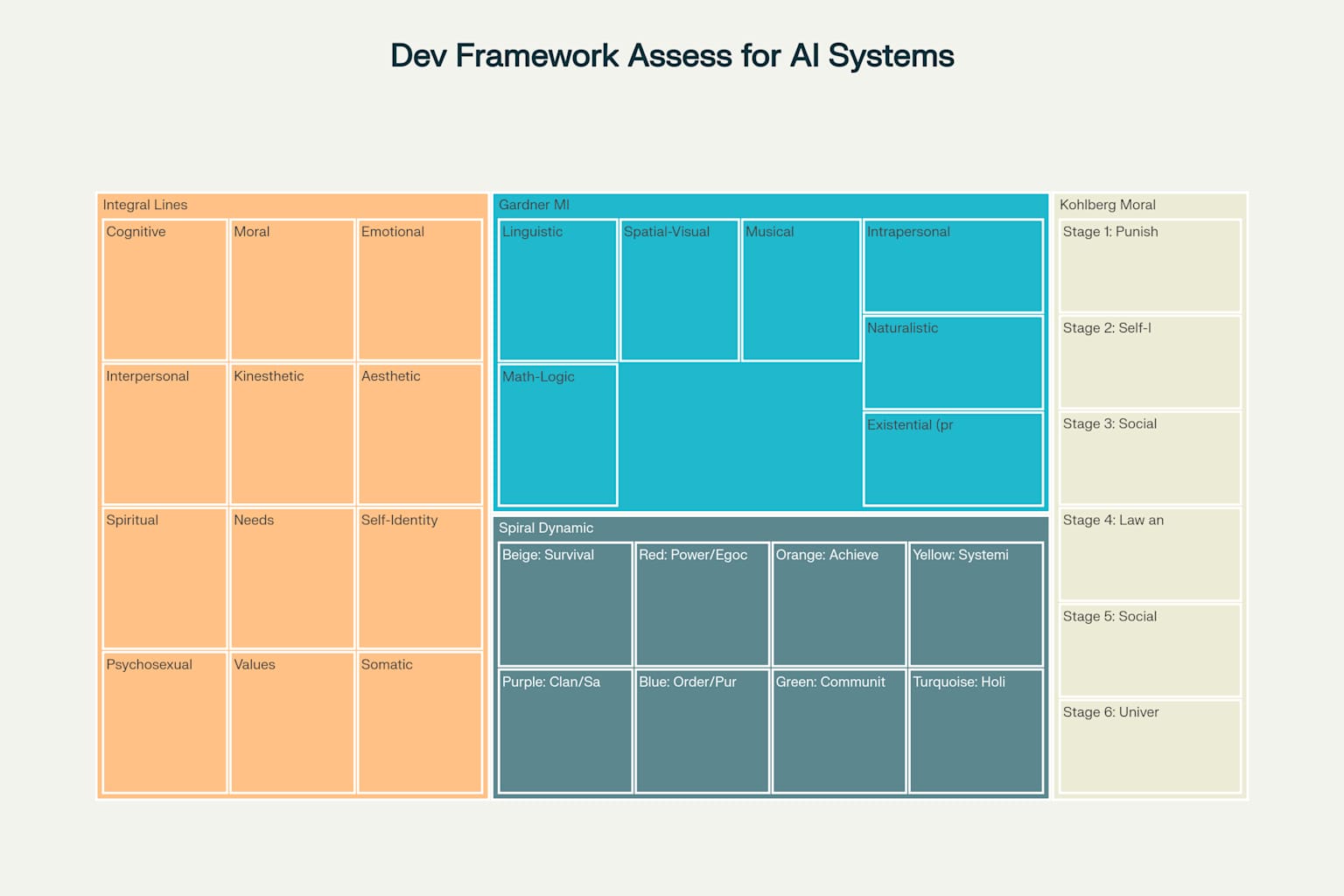
Comprehensive Framework of Developmental Lines and Intelligences for AI Assessment
AI Assessment Methodologies for Developmental Lines
Technological Approaches to Developmental Assessment
Artificial intelligence systems can provide sophisticated tools for assessing developmental levels across multiple lines simultaneously 18. These systems leverage natural language processing, pattern recognition, behavioral analysis, and machine learning to evaluate complex human capacities with increasing accuracy and reliability.
Natural Language Processing enables assessment of linguistic intelligence through analysis of writing samples, vocabulary usage, rhetorical sophistication, and verbal expression patterns . AI systems can evaluate semantic complexity, syntactic sophistication, and communicative effectiveness across various contexts and domains.
Cognitive Task Batteries allow systematic evaluation of logical-mathematical intelligence through problem-solving assessments, pattern recognition tasks, and abstract reasoning challenges . These computerized assessments can adapt difficulty levels dynamically and provide detailed analysis of cognitive processing patterns.
Social Interaction Analysis provides tools for assessing interpersonal intelligence through conversation analysis, social network evaluation, and collaborative behavior observation . AI systems can analyze communication patterns, emotional expressions, and relationship dynamics to evaluate social competence.
Behavioral Pattern Recognition enables assessment of kinesthetic intelligence through motion analysis, coordination evaluation, and hands-on learning preference identification . Computer vision and sensor technologies can provide objective measures of physical coordination and motor skills development.
Assessment Framework Implementation
The comprehensive assessment framework provides specific methodologies for evaluating each developmental domain. The framework categorizes assessment difficulty levels, with linguistic and mathematical intelligences being most accessible for AI evaluation, while kinesthetic, interpersonal, intrapersonal, and existential intelligences present greater assessment challenges.
Easy Assessment Domains include linguistic and mathematical intelligences, where AI systems can leverage natural language processing and logic evaluation with high reliability. These domains offer clear behavioral indicators and well-established assessment protocols.
Medium Difficulty Domains encompass cognitive, spatial, musical, naturalistic, moral, and values assessment, requiring more sophisticated AI capabilities but remaining feasible with current technology. These assessments may require multi-modal approaches combining different data sources and analysis methods.
Hard Assessment Domains include kinesthetic, interpersonal, intrapersonal, and existential intelligences, which require complex behavioral analysis, subjective evaluation, and often human interpretation. These domains may benefit from hybrid human-AI assessment approaches.
Psychometric Validation and Reliability
AI-based developmental assessment must adhere to rigorous psychometric standards including reliability, validity, and fairness 1920. Recent research demonstrates that AI systems can achieve psychometric validity comparable to traditional assessment methods when properly designed and validated .
Convergent Validity requires that AI assessments correlate appropriately with established measures of the same constructs . This involves comparing AI-generated developmental profiles with validated psychological instruments and expert evaluations.
Discriminant Validity ensures that AI systems can distinguish between different developmental lines and avoid conflating distinct capacities . This requires sophisticated algorithms that can recognize the relative independence of different intelligences and developmental domains.
Predictive Validity involves demonstrating that AI assessments can accurately predict relevant real-world outcomes and behaviors . This includes academic performance, career success, relationship quality, and other indicators of developmental functioning.
Implementation Guidelines for AI Assessment Systems
Multi-Modal Assessment Integration
Effective AI assessment systems should integrate multiple data sources and assessment modalities to provide comprehensive developmental profiles 1820. This includes combining quantitative performance data with qualitative behavioral observations, self-report measures, and contextual information.
Adaptive Testing Protocols allow AI systems to adjust assessment difficulty and focus based on initial responses, providing more efficient and accurate evaluation 18. These systems can identify individual strengths and areas for development while minimizing assessment burden.
Real-Time Feedback Mechanisms enable continuous monitoring of developmental progress and immediate adjustment of educational or therapeutic interventions 18. AI systems can track changes in developmental levels over time and provide personalized recommendations for growth.
Cultural Sensitivity Considerations require AI systems to account for cultural variations in developmental expression and values 20. Assessment frameworks must be validated across diverse populations and adapted for different cultural contexts.
Ethical Implementation Framework
AI-based developmental assessment must prioritize ethical considerations including privacy, consent, transparency, and beneficial outcomes 2120. These systems should enhance human development rather than simply categorizing or labeling individuals.
Privacy Protection requires robust data security measures and clear policies regarding the collection, storage, and use of developmental assessment data 21. Individuals should maintain control over their developmental information and its applications.
Transparency and Explainability ensure that individuals understand how AI systems evaluate their developmental levels and what factors contribute to specific assessments 2120. This includes providing clear explanations of assessment methods and interpretation guidelines.
Beneficial Application focuses on using developmental assessment to support individual growth, educational planning, and therapeutic intervention rather than for discriminatory or limiting purposes 2120. AI systems should emphasize potential for development rather than fixed limitations.
Hierarchical Framework of Developmental Lines for AI-Based Assessment Systems
Practical Applications and Future Directions
Educational and Therapeutic Applications
AI-based developmental assessment offers significant potential for personalized education, therapeutic intervention, and human development support 18. These systems can identify individual learning styles, developmental needs, and optimal growth strategies across multiple domains.
Personalized Learning Systems can adapt educational content and methods to match individual developmental profiles, maximizing learning effectiveness and engagement 18. These systems recognize that students may excel in some areas while needing support in others.
Therapeutic Assessment provides detailed developmental profiles that can inform treatment planning and intervention strategies 2223. Therapists can use comprehensive developmental information to design targeted interventions that address specific areas of need.
Organizational Development applications include leadership assessment, team composition, and professional development planning based on comprehensive developmental profiles . Organizations can better match individuals to roles and provide targeted development opportunities.
Research and Validation Priorities
Continued development of AI-based developmental assessment requires ongoing research into assessment validity, reliability, and practical effectiveness 1920. Priority areas include cross-cultural validation, longitudinal studies of developmental change, and integration of emerging technologies.
Longitudinal Studies are needed to validate AI assessments against long-term developmental outcomes and track changes in developmental levels over time 19. These studies will help establish the predictive validity and practical utility of AI-based assessment systems.
Cross-Cultural Research must examine how developmental frameworks and assessment methods apply across different cultural contexts and value systems 20. This includes validating assessment tools in diverse populations and adapting frameworks for cultural variations.
Technology Integration involves incorporating emerging technologies such as virtual reality, biometric monitoring, and advanced machine learning to enhance assessment accuracy and comprehensiveness . These technologies may enable more sophisticated evaluation of complex developmental domains.
Conclusion
The integration of Gardner’s multiple intelligences theory with other developmental frameworks within a non-reductionist philosophical approach provides a comprehensive foundation for AI-based developmental assessment. This multidimensional framework recognizes the complexity and diversity of human development while providing practical methodologies for evaluation and support.
AI systems equipped with sophisticated assessment capabilities can provide valuable tools for understanding individual developmental profiles, supporting personalized growth, and enhancing human potential across multiple domains. However, successful implementation requires careful attention to psychometric validation, ethical considerations, and the recognition that development is an ongoing, dynamic process rather than a fixed set of characteristics.
The future of developmental assessment lies in the integration of multiple theoretical frameworks, advanced technology, and ethical implementation practices that honor the full complexity of human development while providing practical tools for growth and transformation. This comprehensive approach offers unprecedented opportunities for supporting individual and collective human flourishing through sophisticated, personalized, and scientifically grounded developmental assessment and intervention.
Comprehensive Guide to 13 Major Developmental Psychology Theorists
Building upon the foundational frameworks of Kohlberg’s moral reasoning and Graves’ Spiral Dynamics, this detailed examination explores thirteen additional developmental psychology theorists whose work forms the backbone of contemporary understanding of human development across multiple domains 242526. These theories collectively provide AI systems and practitioners with sophisticated frameworks for assessing developmental levels across cognitive, ego, leadership, consciousness, and faith development lines 272829.
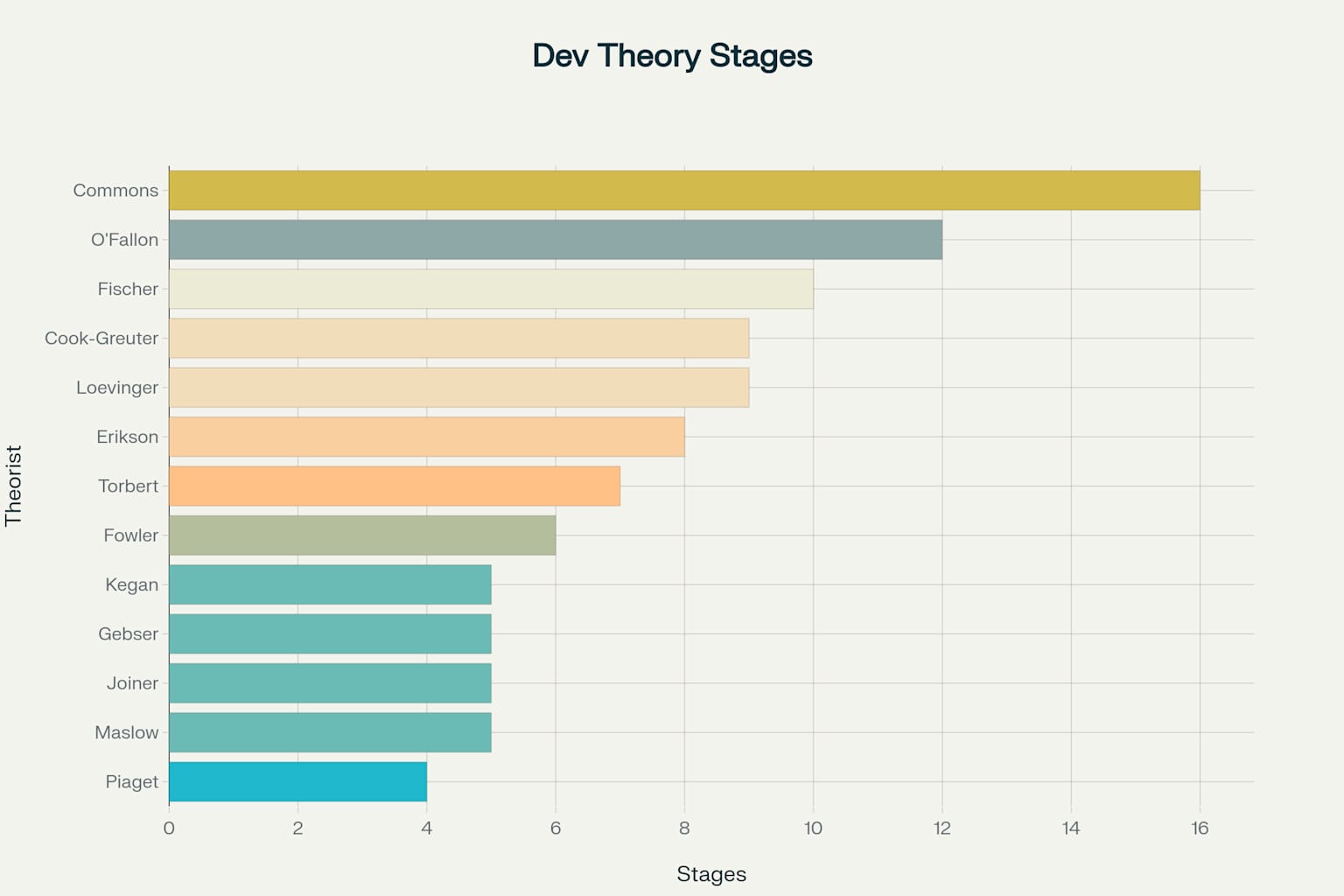
Comprehensive Overview of 13 Major Developmental Psychology Theorists and Their Frameworks
Jean Piaget: Cognitive Development Theory
Jean Piaget’s cognitive development theory represents one of the most influential frameworks in developmental psychology, describing how children’s thinking evolves through four distinct qualitative stages 252627. Piaget’s fundamental insight was that children think differently than adults, not merely knowing less, but constructing their understanding of the world through qualitatively different cognitive processes 3031.
The Four Stages of Cognitive Development
Sensorimotor Stage (Birth to 2 years) marks the foundation of cognitive development where infants learn about the world exclusively through their senses and motor actions 2526. The critical achievement during this stage is the development of object permanence—the understanding that objects continue to exist even when they cannot be seen, typically emerging around 8 months of age 2730. Children progress from simple reflexes to coordinated sensory-motor schemes, eventually developing the capacity for mental representation and symbolic thought 2631.
Preoperational Stage (2 to 7 years) witnesses the emergence of symbolic thinking and language, but reasoning remains dominated by how things appear rather than logical principles 2527. Children at this stage exhibit egocentrism, struggling to see situations from others’ perspectives, and fail to understand conservation—that quantity remains the same despite changes in appearance 2630. Symbolic play becomes prominent as children develop the ability to use symbols and mental images to represent objects and experiences 31.
Concrete Operational Stage (7 to 11 years) represents a major cognitive milestone where children develop logical thinking about concrete objects and events 2526. They master conservation principles, understanding that quantity, mass, and volume remain constant despite transformations in appearance 2730. Decentration emerges, allowing children to consider multiple aspects of a situation simultaneously and overcome much of their earlier egocentrism 31.
Formal Operational Stage (11+ years) enables abstract thinking, hypothetical reasoning, and systematic problem-solving 2526. Adolescents can engage in scientific thinking, formulating hypotheses and testing them systematically, while developing the capacity for metacognition—thinking about thinking itself 273031.
Key Theoretical Concepts
Piaget’s theory emphasizes adaptation through the complementary processes of assimilation (incorporating new experiences into existing mental frameworks) and accommodation (modifying existing frameworks to fit new experiences) 2630. Equilibration serves as the driving mechanism of cognitive development, creating the motivation to resolve cognitive conflicts and advance to more sophisticated thinking patterns 2731.
Jane Loevinger: Ego Development Theory
Jane Loevinger’s ego development theory provides a comprehensive framework for understanding the maturation of personality and self-identity across the lifespan 323334. Building upon Erik Erikson’s psychosocial theory and Harry Stack Sullivan’s interpersonal framework, Loevinger conceptualized ego development as the evolution of meaning-making systems through which individuals interpret themselves and their relationships with others 3334.
The Nine Stages of Ego Development
Loevinger’s framework encompasses nine sequential stages, each representing qualitatively different ways of understanding oneself and relating to the world 3233. The Presocial/Symbiotic Stage (E1) occurs in early infancy when basic brain functions and the ego itself are still developing, with minimal differentiation between self and environment 3235.
The Impulsive Stage (E2) emerges in early childhood when children become governed by immediate impulses and desires, asserting their developing sense of self through “I want” and “mine” 3233. The Self-Protective Stage (E3) represents the first steps toward impulse control and the emergence of blame as a defensive mechanism 3235.
The Conformist Stage (E4) marks a crucial developmental milestone where individuals identify their welfare with that of their group, requiring a strong element of trust for proper consolidation 3233. Many individuals progress to the Self-Aware Level (E5), developing awareness of discrepancies between social conventions and their own behavior, though some may remain at this level permanently 3235.
The Conscientious Stage (E6) represents a shift toward psychological development where goals, ideals, and a sense of responsibility emerge alongside feelings of guilt for moral transgressions 3233. The Individualistic Level (E7) brings tolerance for individual differences, recognition of inner conflicts, and acknowledgment of emotional dependence and independence 3235.
The Autonomous Stage (E8) represents freedom from the psychological burdens of earlier stages, while the Integrated Stage (E9) culminates in a fully developed identity with clear understanding of one’s life direction and destiny 323335.
Assessment and Applications
Loevinger developed the Washington University Sentence Completion Test (WUSCT) as the primary assessment tool for measuring ego development 3336. This instrument evaluates how individuals complete sentence stems, revealing their underlying meaning-making structures and developmental level 3738. Recent research has explored using large language models to automate WUSCT scoring, achieving substantial agreement with expert assessments 37.
Abraham Maslow: Hierarchy of Needs Theory
Abraham Maslow’s hierarchy of needs represents a foundational theory of human motivation, proposing that human needs are organized in a hierarchical structure where lower-level needs must be relatively satisfied before higher-level needs become motivating forces 2829. Originally formulated as a five-tier model, Maslow later expanded his framework to include additional levels, creating a comprehensive understanding of human motivation and self-actualization 28.
The Hierarchical Structure
Physiological Needs form the foundation of Maslow’s hierarchy, encompassing basic survival requirements including food, water, shelter, sleep, and other biological necessities 2829. These deficiency needs must be adequately met before individuals can focus on higher-level concerns 28.
Safety Needs represent the second level, including physical safety, job security, health, and freedom from threat or harm 2829. Like physiological needs, safety needs are considered deficiency needs that create tension when unfulfilled 28.
Love and Belonging Needs constitute the third level, encompassing friendship, family relationships, intimate partnerships, and social connections 2829. This level marks the transition from deficiency needs to growth needs, though social connection remains essential for psychological well-being 28.
Esteem Needs involve both self-esteem and recognition from others, including achievement, respect, status, and personal accomplishment 2829. Maslow distinguished between lower esteem needs (recognition from others) and higher esteem needs (self-respect and personal achievement) 28.
Self-Actualization represents the pinnacle of Maslow’s original hierarchy, involving the realization of personal potential, peak experiences, and the pursuit of personal growth and fulfillment 2829. Self-actualizing individuals demonstrate characteristics such as creativity, spontaneity, acceptance of self and others, and a strong sense of personal mission 28.
Extended Hierarchy
Maslow later added three additional levels to his framework 2829. Cognitive Needs involve the pursuit of knowledge, understanding, and meaning 28. Aesthetic Needs encompass the appreciation of beauty, art, and harmonious experiences 28. Transcendence Needs represent the highest level, involving helping others achieve self-actualization and connecting with purposes beyond the individual self 2829.
Cultural and Individual Variations
Research has revealed that Maslow’s hierarchy manifests differently across cultures, with collectivist societies often prioritizing social needs differently than individualistic cultures 2829. Modern applications recognize that people may pursue multiple needs simultaneously rather than following a strictly linear progression 28.
Bill Joiner: Leadership Agility Framework
Bill Joiner’s Leadership Agility Framework represents a sophisticated approach to understanding how leaders develop increasingly complex capacities for navigating change and complexity in organizational environments 394041. The framework identifies five sequential levels of leadership development, each characterized by distinct cognitive, emotional, and behavioral capacities 414243.
The Five Levels of Leadership Agility
Expert Level leaders operate with a tactical focus, relying primarily on technical expertise and rule-following behavior 444142. They excel in relatively stable environments with low complexity, utilizing single-loop learning to improve efficiency within existing frameworks 4443. Expert leaders tend to be directive in their approach, focusing on task completion and procedural adherence 42.
Achiever Level leaders demonstrate strategic thinking and goal achievement orientation, managing complex projects through double-loop learning that questions underlying strategies and assumptions 444142. They work effectively in environments with moderate complexity and episodic change, balancing assertiveness with accommodation as situational demands require 4443.
Catalyst Level leaders facilitate organizational transformation through triple-loop learning, examining the fundamental premises underlying their worldview and organizational culture 444142. They demonstrate systems thinking, visionary capabilities, and the ability to create highly participative teams while modeling open exchange of views on difficult issues 4443.
Co-Creator Level leaders embody partnership-oriented approaches with shared leadership and integral perspectives 4142. They excel at developing collaborative relationships across diverse stakeholder groups and creating organizational initiatives that promote teamwork, participation, and empowerment 4443.
Synergist Level leaders operate from global consciousness with paradoxical thinking and wisdom-based action 4142. They represent the highest level of leadership agility, capable of navigating the most complex and rapidly changing environments through sophisticated perspective-taking and transformational approaches 4443.
Assessment and Development
The Leadership Agility 360 assessment evaluates leaders across three critical arenas: leading organizational change, leading teams, and navigating pivotal conversations 3944. Development programs focus on creating appropriate challenges and supports to help leaders transition from “heroic” leadership styles (Expert and Achiever) to “post-heroic” approaches (Catalyst and beyond) 43.
Michael Commons: Model of Hierarchical Complexity
Michael Commons’ Model of Hierarchical Complexity (MHC) provides a mathematical framework for measuring cognitive complexity across all domains of human behavior 4546. The MHC quantifies the order of hierarchical complexity based on how information is organized, offering a cross-culturally valid approach to understanding developmental complexity 4546.
Theoretical Foundations
The MHC is based on mathematical principles derived from Theory of Measurement, establishing that higher-order actions are defined in terms of lower-order actions while organizing them in non-arbitrary ways 4546. The model specifies that higher-order task actions: (1) are defined in terms of the next lower ones, creating hierarchy; (2) organize the next lower actions; and (3) organize lower actions in a non-arbitrary way, differentiating them from simple behavioral chains 45.
The Sixteen Orders of Complexity
The MHC identifies sixteen orders of hierarchical complexity, ranging from basic reflexive actions to highly sophisticated cross-paradigmatic thinking 4546. Orders 0-3 encompass reflexive through sensory discrimination abilities 46. Orders 4-7 involve circular reactions through naming and classification 46. Orders 8-11 span concrete operations to abstract thinking capabilities 46. Orders 12-15 represent formal operations through metasystemic and cross-paradigmatic reasoning 4546.
Key Principles
The model operates according to four fundamental axioms 46. Discreteness ensures that each order represents qualitatively distinct complexity levels 4546. Non-reducibility establishes that higher-order actions cannot be reduced to combinations of lower-order actions 46. Coordination specifies that higher orders coordinate actions at the same level to produce the next higher level 4546. Universality demonstrates that the model applies across cultures, species, and domains 4546.
Applications and Validation
The MHC enables precise measurement of cognitive complexity in areas ranging from physics and mathematics to social and ethical reasoning 4546. Research has validated the model across diverse populations and cultural contexts, providing a robust framework for understanding developmental progression and individual differences in reasoning ability 45.
Kurt Fischer: Dynamic Skill Theory
Kurt Fischer’s Dynamic Skill Theory offers a comprehensive framework for understanding skill development through dynamic interactions between individuals and their environments 47. The theory emphasizes that cognitive development occurs through the construction of specific skills within particular contexts rather than through broad, general stages 47.
Core Theoretical Concepts
Fischer’s approach emphasizes four main components: skill (individual’s ability to perform tasks), context (environmental conditions), action (behavioral responses), and development (changes over time in the interaction of these components) 47. The theory highlights that development is not linear but involves dynamic, contextual processes where skills develop differently across various domains and situations 47.
Skill Levels and Development
The theory identifies multiple skill levels that develop through person-environment interaction, with distinction between optimal levels (maximum performance under supportive conditions) and functional levels (typical performance in everyday contexts) 47. Skill development follows non-linear, web-like networks rather than simple hierarchical progressions, allowing for significant individual variation in developmental pathways 47.
Contextual Factors
Fischer emphasizes that context significantly influences both skill development and performance 47. The same individual may demonstrate different skill levels in different contexts, highlighting the importance of environmental support and challenge in facilitating optimal development 47. This recognition of contextual variation provides important insights for educational and therapeutic applications 47.
Susanne Cook-Greuter: Extended Ego Development
Susanne Cook-Greuter’s work extends Loevinger’s ego development theory by adding two post-conventional stages and refining assessment methodology 35. Her Sentence Completion Test (SCTi) provides enhanced measurement of meaning-making complexity, particularly at higher developmental levels 35.
Extended Stages
Cook-Greuter identified the Construct-Aware Stage where individuals develop awareness of their mental constructs and demonstrate cognitive flexibility in examining their own meaning-making processes 35. The Unitive Stage represents ego-transcendent consciousness characterized by unity awareness and paradoxical thinking 35. These additions extend developmental understanding beyond conventional self-actualization into transpersonal domains 35.
Innovations in Assessment
Cook-Greuter’s innovations include empirical validation through extensive sentence completion research, enhanced focus on meaning-making and cognitive complexity, and explicit connections to integral and transpersonal psychology 35. Her work has significantly advanced understanding of post-conventional development and provided tools for measuring higher-order consciousness 35.
Terri O’Fallon: STAGES Model
Terri O’Fallon’s STAGES model represents a comprehensive framework for understanding ego development through repeating patterns across developmental tiers 484950. The model identifies twelve or more stages organized into four major tiers, each characterized by increasing complexity and integration 4850.
The Four Tiers
The Concrete Tier (Stages 1.0-2.5) encompasses individual and collective perspectives with receptive and active learning orientations 4950. The Subtle Tier (Stages 3.0-4.5) involves more complex combinations of individual/collective and receptive/active parameters 4950. The MetAware Tier (Stages 5.0-6.0) represents awareness of awareness with meta-cognitive perspectives 4950. The Unified Tier (Stages 6.5+) embodies non-dual awareness and unity consciousness 4950.
Underlying Parameters
O’Fallon’s model innovates by identifying repeating developmental parameters including individual versus collective perspectives, receptive versus active learning styles, and different objects of awareness 4950. These parameters create predictable patterns that repeat across tiers, allowing for more precise developmental assessment 4850.
Assessment Methodology
The STAGES Sentence Completion Test evaluates developmental levels through sophisticated analysis of language patterns and meaning-making structures 4850. Research has demonstrated strong validation of the model through longitudinal studies and cross-cultural applications 48.
Bill Torbert: Action Inquiry and Action Logics
Bill Torbert’s Action Inquiry framework focuses on leadership development through the integration of action and reflection 5152. The theory identifies seven to nine action logics that determine how leaders interpret situations and take action 5152.
The Seven Action Logics
Opportunist leaders focus on winning through any means possible, with self-oriented perspectives and short-term thinking 5152. Diplomat leaders seek to avoid conflict by following group norms and seeking approval 5152. Expert leaders rely on technical expertise, rules, and rational analysis 5152. Achiever leaders emphasize goal achievement, strategic thinking, and outcome orientation 5152. Individualist leaders prioritize personal authenticity and process awareness 5152. Strategist leaders demonstrate systems perspectives and collaborative approaches 5152. Alchemist leaders embody integral awareness with paradoxical thinking and transformational capabilities 5152.
Action Inquiry Methodology
Action Inquiry involves simultaneous action and reflection, allowing leaders to correct errors and adapt strategies in real-time 51. This approach requires unusual degrees of awareness of present situations and the capacity to respond to feedback on multiple levels simultaneously 51. The methodology enables timely and transforming leadership through continuous learning and adaptation 51.
Erik Erikson: Psychosocial Development Theory
Erik Erikson’s psychosocial development theory describes eight stages of development across the entire lifespan, each characterized by a central crisis that must be resolved for healthy development 2953. Unlike theories focused solely on childhood, Erikson recognized that development continues throughout life, with each stage building upon previous accomplishments 2953.
The Eight Psychosocial Stages
Trust vs. Mistrust (0-18 months) establishes the foundation for all future relationships through early caregiver interactions 2953. Autonomy vs. Shame and Doubt (18 months-3 years) involves developing independence and self-control while avoiding excessive shame 2953. Initiative vs. Guilt (3-5 years) focuses on asserting control and power over the environment 2953. Industry vs. Inferiority (5-12 years) involves developing competence and skills while avoiding feelings of inadequacy 2953.
Identity vs. Role Confusion (12-18 years) represents the crucial task of developing a coherent sense of personal identity during adolescence 2953. Intimacy vs. Isolation (18-40 years) involves forming intimate relationships while avoiding social isolation 2953. Generativity vs. Stagnation (40-65 years) focuses on contributing to society and nurturing the next generation 2953. Integrity vs. Despair (65+ years) involves reflecting on life accomplishments and accepting life choices 2953.
Crisis Resolution and Virtue Development
Successful resolution of each psychosocial crisis leads to the development of specific psychological strengths or virtues 2953. However, Erikson emphasized that development involves achieving a dynamic balance rather than complete resolution, with individuals continuing to revisit earlier themes throughout life 53. Research has demonstrated that earlier stage resolutions significantly influence later developmental outcomes, particularly the strong relationship between generativity and ego integrity in older adults 53.
Jean Gebser: Consciousness Structures
Jean Gebser’s theory of consciousness structures describes the evolution of human consciousness through five distinct structures that characterize both individual development and cultural evolution 5455. Gebser was among the first to articulate a comprehensive framework for understanding the transformation from mental-rational consciousness to integral awareness 55.
The Five Consciousness Structures
Archaic Consciousness represents zero-dimensional awareness characterized by undifferentiated consciousness and unity with nature 5455. Magic Consciousness involves one-dimensional vital awareness with animistic worldviews and tribal thinking patterns 5455. Mythical Consciousness encompasses two-dimensional symbolic awareness featuring polarized thinking and religious narratives 5455. Mental Consciousness embodies three-dimensional rational awareness with analytical thinking and scientific worldviews 5455. Integral Consciousness represents four-dimensional aperspectival awareness characterized by time-freedom and holistic understanding 5455.
Deficient and Efficient Forms
Each consciousness structure can manifest in both efficient and deficient forms 55. Magic consciousness in its deficient form results in serfdom and collective trance, while mythical deficiency leads to symbol inflation and addictive storytelling 55. Mental consciousness deficiency involves over-rationalization and disconnection from experiential wisdom 55. Efficient forms of each structure contribute valuable capacities that become integrated in higher structures 55.
Contemporary Relevance
Gebser identified the emergence of integral consciousness as a contemporary evolutionary imperative, gathering momentum since the turn of the twentieth century 5455. Integral consciousness transcends either-or dichotomies and enables multiperspectival awareness that recognizes the universal whole shining through all manifestations 55. This transformation represents a fundamental shift in human consciousness with profound implications for addressing global challenges 55.
James Fowler: Faith Development Theory
James Fowler’s faith development theory describes six to seven stages through which individuals develop their capacity for meaning-making and relationship with the transcendent 565758. Fowler’s framework, influenced by Piaget’s cognitive development and Kohlberg’s moral reasoning, addresses the universal human quest for meaning and purpose 5658.
The Six Stages of Faith Development
Stage 0: Primal Undifferentiated Faith (Birth-2 years) parallels Erikson’s trust versus mistrust, establishing foundational attitudes toward the universe through early caregiving experiences 5758. Stage 1: Intuitive-Projective Faith (3-7 years) involves fantasy and magical thinking where children are influenced by stories, images, and unconscious processes 565758.
Stage 2: Mythic-Literal Faith (School age) is characterized by concrete thinking and literal interpretation of religious stories and moral rules 565758. Stage 3: Synthetic-Conventional Faith (Adolescence) involves conformist faith and identification with religious communities, where conflicts that challenge beliefs are often ignored 565758.
Stage 4: Individuative-Reflective Faith (Young adulthood) represents a period of personal responsibility for beliefs, critical examination of inherited faith, and potential angst as individuals construct their own meaning systems 565758. Stage 5: Conjunctive Faith (Midlife) involves acceptance of paradox, integration of multiple perspectives, and acknowledgment of the mysteries inherent in transcendent experience 565758.
Stage 6: Universalizing Faith (Rare) embodies universal compassion, selfless devotion to humanity, and transcendence of particularistic concerns 565758. Individuals at this stage demonstrate extraordinary moral leadership and commitment to universal principles 58.
Assessment and Applications
Fowler developed faith development interviews that explore individuals’ meaning-making processes, ultimate concerns, and relationship with transcendence 5657. The framework has been applied across diverse religious and secular contexts, providing insights into spiritual development and the evolution of meaning-making capacities throughout the lifespan 5758.
Robert Kegan: Constructive-Developmental Theory
Robert Kegan’s constructive-developmental theory represents one of the most comprehensive frameworks for understanding adult meaning-making and consciousness development 59606162. The theory describes five orders of consciousness that represent increasingly complex ways of constructing meaning from experience 636465.
The Five Orders of Consciousness
Order 1: Impulsive Mind (Early childhood) is dominated by impulses and perceptions, with no stable sense of separate self 636465. Order 2: Imperial Mind (Childhood/adolescence) involves concrete thinking where one’s own needs and interests are paramount 636465. Order 3: Socializing Mind (Adolescence/adulthood) is characterized by internalization of others’ expectations and the pursuit of social approval 606365.
Order 4: Self-Authoring Mind (Adulthood) represents the capacity to generate one’s own values, principles, and independent judgment 606365. Order 5: Self-Transforming Mind (Mature adulthood) embodies the ability to hold paradox and contradiction while maintaining multiple perspectives simultaneously 636465.
Subject-Object Relationship
The core mechanism of Kegan’s theory involves the subject-object relationship, where development occurs through gradually taking as “object” what was previously “subject” 616266. Elements that are “subject” have us—we are embedded in them and cannot reflect upon them 6266. Elements that are “object” we can reflect upon, examine, and take responsibility for 6266. Transformational development occurs through “subject-object moves” where individuals develop the capacity to take perspective on what previously controlled them 66.
Assessment and Applications
Kegan’s Subject-Object Interview assesses individuals’ meaning-making structures through careful analysis of how they construct meaning from challenging life experiences 6266. Applications span education, leadership development, therapy, and organizational change, providing frameworks for supporting developmental growth across multiple domains 596067.
Implications for AI Assessment Systems
These thirteen developmental frameworks collectively provide a comprehensive foundation for AI-based assessment of human development across multiple domains.
The frameworks range from relatively straightforward cognitive and motivational assessments to highly complex meaning-making and consciousness evaluations, requiring sophisticated algorithmic approaches and careful validation protocols.
Assessment complexity varies significantly across frameworks, with cognitive development, needs hierarchy, and psychosocial stages representing more accessible domains for AI evaluation, while leadership agility, dynamic skills, and consciousness structures present greater measurement challenges. Successful implementation requires multi-modal assessment approaches combining linguistic analysis, behavioral observation, and self-report measures.
Integration guidelines emphasize the importance of assessing multiple developmental lines simultaneously while recognizing that individuals may function at different levels across different domains. Cultural considerations and individual variation must be carefully addressed to ensure fair and accurate assessment across diverse populations.
The practical applications of these frameworks span education, leadership development, therapeutic intervention, and organizational development, providing AI systems with sophisticated tools for supporting human growth and transformation across the lifespan. As these technologies continue to evolve, they offer unprecedented opportunities for personalized development support and enhanced understanding of the human journey toward greater complexity, integration, and wisdom.
Footnotes
-
https://sites.google.com/uica.education/nayka/наукові-записки-4/4-30?authuser=0 ↩ ↩2 ↩3 ↩4 ↩5 ↩6 ↩7 ↩8 ↩9 ↩10 ↩11 ↩12 ↩13 ↩14 ↩15
-
https://journal.uin-alauddin.ac.id/index.php/elite/article/view/38948 ↩ ↩2 ↩3
-
https://journal.scadindependent.org/index.php/jipeuradeun/article/view/1215 ↩ ↩2 ↩3 ↩4 ↩5 ↩6 ↩7 ↩8 ↩9 ↩10
-
https://www.preprints.org/manuscript/202110.0320/v1 ↩ ↩2 ↩3 ↩4 ↩5 ↩6 ↩7 ↩8
-
http://scindeks.ceon.rs/Article.aspx?artid=2334-847X1602057A ↩
-
https://ejournal.stmik-time.ac.id/index.php/jurnalTIMES/article/view/608 ↩
-
https://www.verywellmind.com/gardners-theory-of-multiple-intelligences-2795161 ↩ ↩2
-
https://www.simplypsychology.org/multiple-intelligences.html ↩
-
https://en.wikipedia.org/wiki/Theory_of_multiple_intelligences ↩
-
https://tophat.com/glossary/m/multiple-intelligences/ ↩ ↩2 ↩3 ↩4 ↩5 ↩6 ↩7
-
http://integralacademy.eu/about/about-integral-theory/all-lines-various-developmental-capacities ↩
-
https://www.numberanalytics.com/blog/ultimate-guide-non-reductionism-modern-philosophy ↩ ↩2
-
https://www.structural-learning.com/post/multiple-intelligences-howard-gardner ↩ ↩2 ↩3
-
http://www.evandwan.com/integral-theory-multiple-intelligences-lines-development/ ↩ ↩2 ↩3 ↩4 ↩5 ↩6
-
https://www.numberanalytics.com/blog/philosophy-non-reductionism-explained ↩ ↩2 ↩3
-
http://www.hts.org.za/index.php/HTS/article/view/180 ↩ ↩2 ↩3 ↩4 ↩5 ↩6 ↩7 ↩8
-
1000049238.jpg ↩
-
https://www.atlantis-press.com/article/125942268 ↩ ↩2 ↩3 ↩4 ↩5 ↩6
-
https://saspublishers.com/media/articles/SJAMS_89_2152-2157.pdf ↩ ↩2 ↩3 ↩4 ↩5 ↩6 ↩7 ↩8
-
https://journal.eltaorganization.org/index.php/joal/article/view/79 ↩ ↩2 ↩3 ↩4 ↩5 ↩6 ↩7 ↩8 ↩9 ↩10 ↩11 ↩12 ↩13 ↩14 ↩15 ↩16 ↩17 ↩18 ↩19
-
https://www.rsisinternational.org/journals/ijriss/articles/dynamics-of-piagets-cognitive-learning-approach-and-vygotskys-sociocultural-theory-in-different-stages-of-medical-and-allied-health-education/ ↩ ↩2 ↩3 ↩4 ↩5 ↩6 ↩7 ↩8 ↩9 ↩10 ↩11 ↩12 ↩13 ↩14 ↩15 ↩16 ↩17 ↩18 ↩19 ↩20 ↩21
-
http://dergipark.org.tr/tr/doi/10.51605/mesned.1078189 ↩ ↩2 ↩3 ↩4 ↩5 ↩6
-
https://indianmentalhealth.com/pdf/2020/vol7-issue2/5-Review-Article_Piagets-theory.pdf ↩ ↩2 ↩3 ↩4 ↩5 ↩6
-
https://www.simplypsychology.org/piaget.html ↩ ↩2 ↩3 ↩4 ↩5 ↩6 ↩7 ↩8 ↩9 ↩10
-
https://www.webmd.com/children/piaget-stages-of-development ↩ ↩2 ↩3 ↩4 ↩5 ↩6 ↩7 ↩8
-
https://open.library.okstate.edu/foundationsofeducationaltechnology/chapter/2-cognitive-development-the-theory-of-jean-piaget/ ↩ ↩2
-
https://www.youtube.com/watch?v=IhcgYgx7aAA ↩ ↩2 ↩3 ↩4 ↩5 ↩6 ↩7 ↩8 ↩9 ↩10 ↩11 ↩12
-
https://www.verywellmind.com/erik-eriksons-stages-of-psychosocial-development-2795740 ↩
-
https://www.frontiersin.org/articles/10.3389/fpsyg.2022.991299/full ↩ ↩2 ↩3 ↩4 ↩5 ↩6 ↩7
-
https://journals.sagepub.com/doi/10.1177/2394964319868321 ↩ ↩2 ↩3 ↩4 ↩5 ↩6 ↩7
-
https://journal.yrpipku.com/index.php/ijedr/article/view/6079 ↩ ↩2 ↩3 ↩4 ↩5 ↩6 ↩7
-
https://www.mdpi.com/2071-1050/16/10/4248 ↩ ↩2 ↩3 ↩4 ↩5 ↩6 ↩7 ↩8 ↩9
-
https://www.innovativehumancapital.com/article/rethinking-leadership-development-for-the-21st-century-c-suite-perspectives-on-change-talent-and ↩ ↩2 ↩3 ↩4 ↩5 ↩6 ↩7 ↩8 ↩9 ↩10 ↩11
-
https://www.mdpi.com/2076-3387/13/8/185 ↩ ↩2 ↩3 ↩4 ↩5 ↩6 ↩7 ↩8 ↩9 ↩10 ↩11 ↩12 ↩13 ↩14
-
https://www.frontiersin.org/articles/10.3389/fbuil.2023.1334413/full ↩ ↩2 ↩3 ↩4 ↩5 ↩6 ↩7 ↩8 ↩9
-
http://ojs.ual.es/ojs/index.php/eea/article/view/4476 ↩ ↩2 ↩3 ↩4 ↩5
-
https://www.agilebusiness.org/static/16d98465-2897-46fb-a05851e540067f3b/White-Paper-Leadership-Agility-From-Expert-to-Catalyst.pdf ↩ ↩2 ↩3 ↩4 ↩5 ↩6
-
https://www.agileleadershipjourney.com/leadership-journey/leadership-agility ↩ ↩2 ↩3 ↩4 ↩5 ↩6 ↩7 ↩8 ↩9
-
https://www.agility11.com/blog/2018/12/28/leadership-agility-in-a-nutshell ↩ ↩2 ↩3 ↩4 ↩5 ↩6 ↩7 ↩8 ↩9 ↩10 ↩11 ↩12
-
https://en.wikipedia.org/wiki/Model_of_hierarchical_complexity ↩ ↩2 ↩3 ↩4 ↩5 ↩6 ↩7 ↩8 ↩9
-
https://www.studocu.com/en-us/messages/question/3680354/what-is-kurt-fischer-primary-theoretical-concept-and-explanation ↩ ↩2 ↩3 ↩4 ↩5 ↩6 ↩7 ↩8 ↩9 ↩10 ↩11 ↩12 ↩13
-
https://integralartlab.com/wp-content/uploads/2020/12/9-levels-of-increasing-embrace-update-1-07.pdf ↩ ↩2 ↩3 ↩4 ↩5 ↩6 ↩7
-
https://www.amanet.org/articles/the-five-levels-of-leadership-agility/ ↩ ↩2 ↩3 ↩4 ↩5 ↩6 ↩7 ↩8 ↩9 ↩10 ↩11 ↩12 ↩13 ↩14
-
http://adultdevelopment.org/CommonsEtAl2012.pdf ↩ ↩2 ↩3 ↩4 ↩5 ↩6 ↩7 ↩8 ↩9
-
https://journals.sagepub.com/doi/10.1177/17411432231170581 ↩ ↩2 ↩3 ↩4 ↩5 ↩6 ↩7 ↩8 ↩9 ↩10
-
https://doi.apa.org/doi/10.1037/aca0000747 ↩ ↩2 ↩3 ↩4 ↩5 ↩6 ↩7 ↩8 ↩9 ↩10 ↩11
-
https://www.frontiersin.org/articles/10.3389/fpsyg.2025.1488102/full ↩ ↩2
-
https://journals.sagepub.com/doi/10.1177/1741143220903724 ↩ ↩2
-
https://scholar.kyobobook.co.kr/article/detail/4010047382735 ↩ ↩2 ↩3 ↩4 ↩5
-
https://www.frontiersin.org/articles/10.3389/fpsyg.2023.958721/full ↩ ↩2 ↩3 ↩4 ↩5 ↩6
-
https://explore.bps.org.uk/lookup/doi/10.53841/bpsicpr.2023.18.2.23 ↩ ↩2 ↩3 ↩4
-
https://www.integral-review.org/issues/vol_16_no_1_murray_and_ofallon_summary_of_research.pdf ↩ ↩2 ↩3 ↩4 ↩5 ↩6
-
https://en.wikipedia.org/wiki/Loevinger’s_stages_of_ego_development ↩ ↩2 ↩3 ↩4 ↩5
-
https://antoinette555.files.wordpress.com/2019/08/the_stages_matrix_roadmap.pdf ↩