Non-Reductionist Personality Typing Systems: A Comprehensive Guide for AI Implementation
Executive Summary
Non-reductionist philosophy provides a meta-theoretical framework that integrates multiple personality typing systems rather than reducing human complexity to any single model 1. This approach recognizes that personality emerges from multiple interconnected factors and requires holistic understanding rather than reductive categorization 2. The four primary systems—MBTI, Big Five/OCEAN, HEXACO, Enneagram, and Attachment Theory—each offer unique insights that, when combined, provide comprehensive personality assessment capabilities for AI systems 3.
Non-Reductionist Philosophical Foundation
Core Principles
Non-reductionist philosophy emphasizes meta-theoretical integration that synthesizes diverse perspectives into coherent wholes while maintaining intellectual rigor 1. This framework recognizes consciousness as an emergent property arising from natural systems, biological processes, and social interactions rather than a fundamental ground of reality 1. The approach advocates for sacred naturalism, which honors the full complexity of human personality without reducing it to simple categories or supernatural explanations 1.
The philosophy promotes active engagement over passive contemplation, encouraging the use of personality insights for growth and transformation rather than static labeling 1. It requires qualified leadership with deep understanding before making personality assessments, ensuring ethical standards in AI implementation 1. Finally, it embraces ongoing development, recognizing personality as dynamic and evolving rather than fixed 1.
Application to Personality Assessment
In personality assessment, non-reductionist principles translate into integrating multiple typing systems simultaneously rather than relying on single approaches 4. This methodology views personality as emerging from interconnected psychological, biological, and social factors that cannot be fully understood through reductive analysis 2. The approach demands respect for human dignity and complexity in AI assessments while providing actionable insights for personal development 4.
Myers-Briggs Type Indicator (MBTI)
Theoretical Foundation
The MBTI system, based on Carl Jung’s cognitive functions theory, identifies 16 personality types through four key dimensions: Extraversion/Introversion (E/I), Sensing/Intuition (S/N), Thinking/Feeling (T/F), and Judging/Perceiving (J/P) 56. The system emphasizes psychological preferences in how individuals perceive information and make decisions rather than measuring abilities or traits 7. Each type represents a unique combination of cognitive functions arranged in a specific hierarchy 8.
Cognitive Functions System
The foundation of MBTI lies in eight cognitive functions: Introverted and Extraverted versions of Thinking (Ti/Te), Feeling (Fi/Fe), Intuition (Ni/Ne), and Sensing (Si/Se) 98. These functions operate in a specific stack for each personality type, with a dominant function leading, supported by auxiliary, tertiary, and inferior functions 8. The cognitive functions represent different mental processes for gathering information and making decisions 9.
AI Implementation Indicators
For AI systems, MBTI identification relies on analyzing language patterns reflecting cognitive preferences, decision-making styles, and communication patterns 1011. Key indicators include information processing preferences (detailed vs. big-picture thinking), problem-solving approaches (logical vs. values-based), and social interaction styles (energy from external vs. internal sources) 126. Machine learning models can achieve 70-85% accuracy by analyzing social media posts, writing samples, and digital communication patterns 1314.
Big Five (OCEAN) Model
Structure and Dimensions
The Big Five model measures personality traits along five continuous dimensions: Openness to experience (creativity, curiosity, intellectual engagement), Conscientiousness (organization, discipline, goal-orientation), Extraversion (sociability, energy, assertiveness), Agreeableness (cooperation, trust, empathy), and Neuroticism (emotional stability, anxiety levels) 1516. Each trait exists on a spectrum rather than as discrete categories, allowing for nuanced assessment 16.
AI Detection Methods
AI systems can identify Big Five traits through linguistic feature extraction and behavioral prediction models with 80-90% accuracy 1714. Detection methods include analyzing language patterns indicating trait levels, behavioral descriptions in text, response patterns to various situations, and social media activity patterns 1815. The system’s strength lies in its empirical validation and cross-cultural stability 16.
HEXACO Six-Factor Model
Enhanced Framework
The HEXACO model expands the Big Five by adding Honesty-Humility as a sixth dimension, providing more comprehensive personality assessment 1920. This additional factor measures sincerity, fairness, greed avoidance, and modesty—distinguishing honest from manipulative behavior patterns 2122. The six factors are: Honesty-Humility, Emotionality, eXtraversion, Agreeableness, Conscientiousness, and Openness 19.
Unique Value Proposition
The Honesty-Humility dimension captures personality aspects not adequately measured by the Big Five, particularly relating to ethical behavior and interpersonal manipulation 20. Research shows this factor significantly predicts behaviors involving deceit, exploitation, and material gain 21. For AI systems, this model offers 75-85% accuracy potential while providing insights into integrity-related personality characteristics 22.
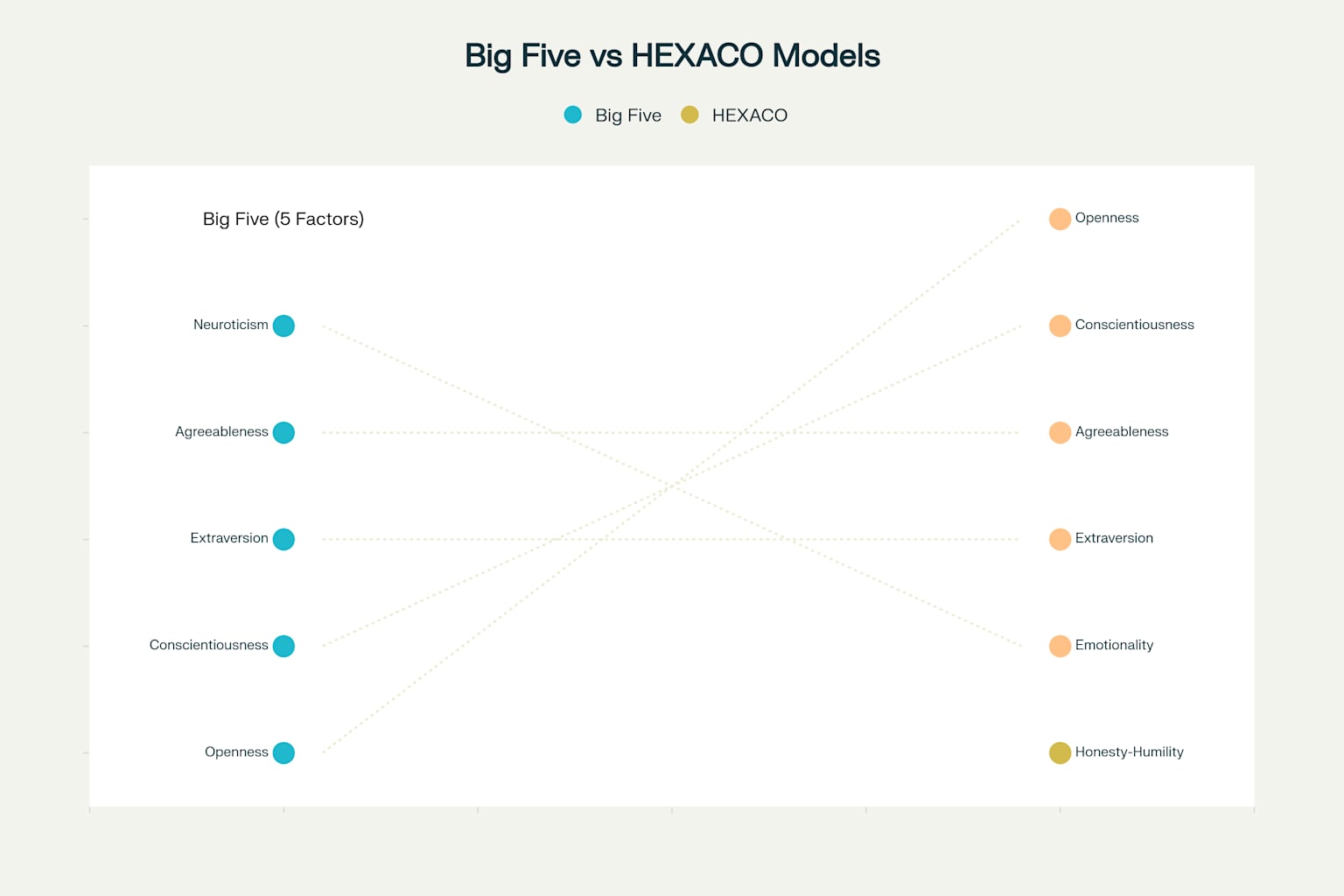
Big Five vs HEXACO: Evolution from Five-Factor to Six-Factor Personality Model
Enneagram of Personality
Core Structure
The Enneagram identifies nine personality types based on core motivations, fears, and desires rather than observable behaviors 2324. The system organizes types into three centers of intelligence: Body/Gut types (8, 9, 1) focused on control and action, Heart/Feeling types (2, 3, 4) concerned with image and relationships, and Head/Thinking types (5, 6, 7) dealing with security and thinking 2524. Each type has distinct core fears, desires, and coping mechanisms 26.
Dynamic Relationships
The Enneagram includes dynamic elements such as integration and disintegration directions showing how types change under stress and growth conditions 24. Wings represent influence from adjacent types, while instinctual variants (self-preservation, social, sexual) add further nuance 24. These dynamic aspects make the system complex but provide rich insights into personality development and change 23.
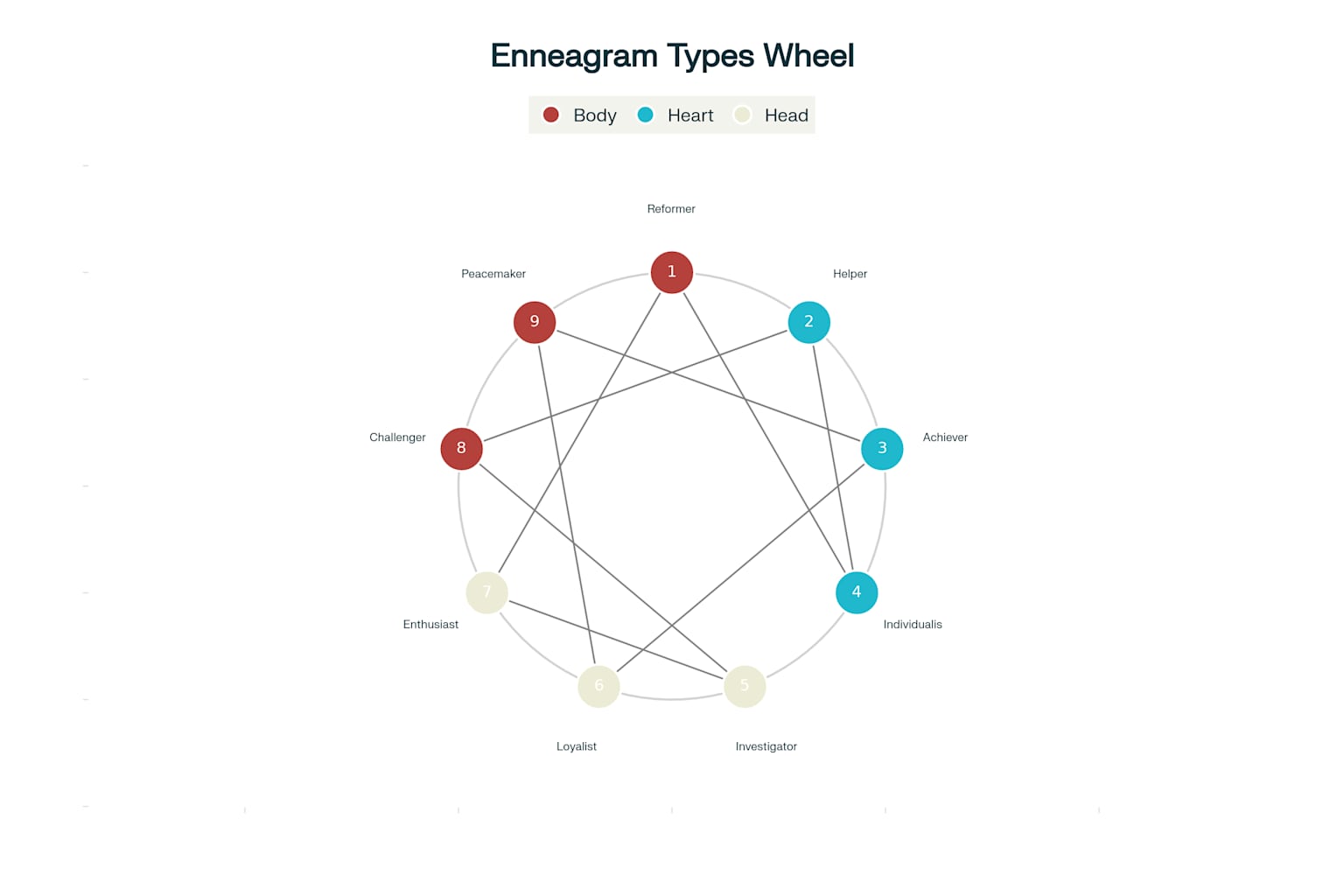
The Enneagram of Personality: Nine Types Organized by Centers of Intelligence
AI Implementation Challenges
Enneagram typing through AI presents unique challenges because it focuses on internal motivations rather than external behaviors 27. AI systems must analyze core motivation expressions, fear and avoidance patterns, desire language, and coping mechanism descriptions 2829. Current accuracy potential ranges from 65-80% due to the subjective nature of motivational assessment 27.
Attachment Theory
Four Attachment Styles
Attachment theory identifies four primary styles based on early caregiver relationships: Secure (60% of population), Anxious (20%), Avoidant (15%), and Disorganized (5%) 3031. Secure attachment develops from consistent, responsive caregiving and results in comfort with both intimacy and autonomy 3233. Anxious attachment stems from inconsistent caregiving, leading to craving closeness while fearing abandonment 3435.
Avoidant attachment emerges from rejecting or emotionally unavailable caregiving, resulting in valuing independence while feeling uncomfortable with closeness 36. Disorganized attachment, the rarest and most problematic, develops from frightening or chaotic caregiving and creates simultaneous desire for and fear of intimacy 3536.
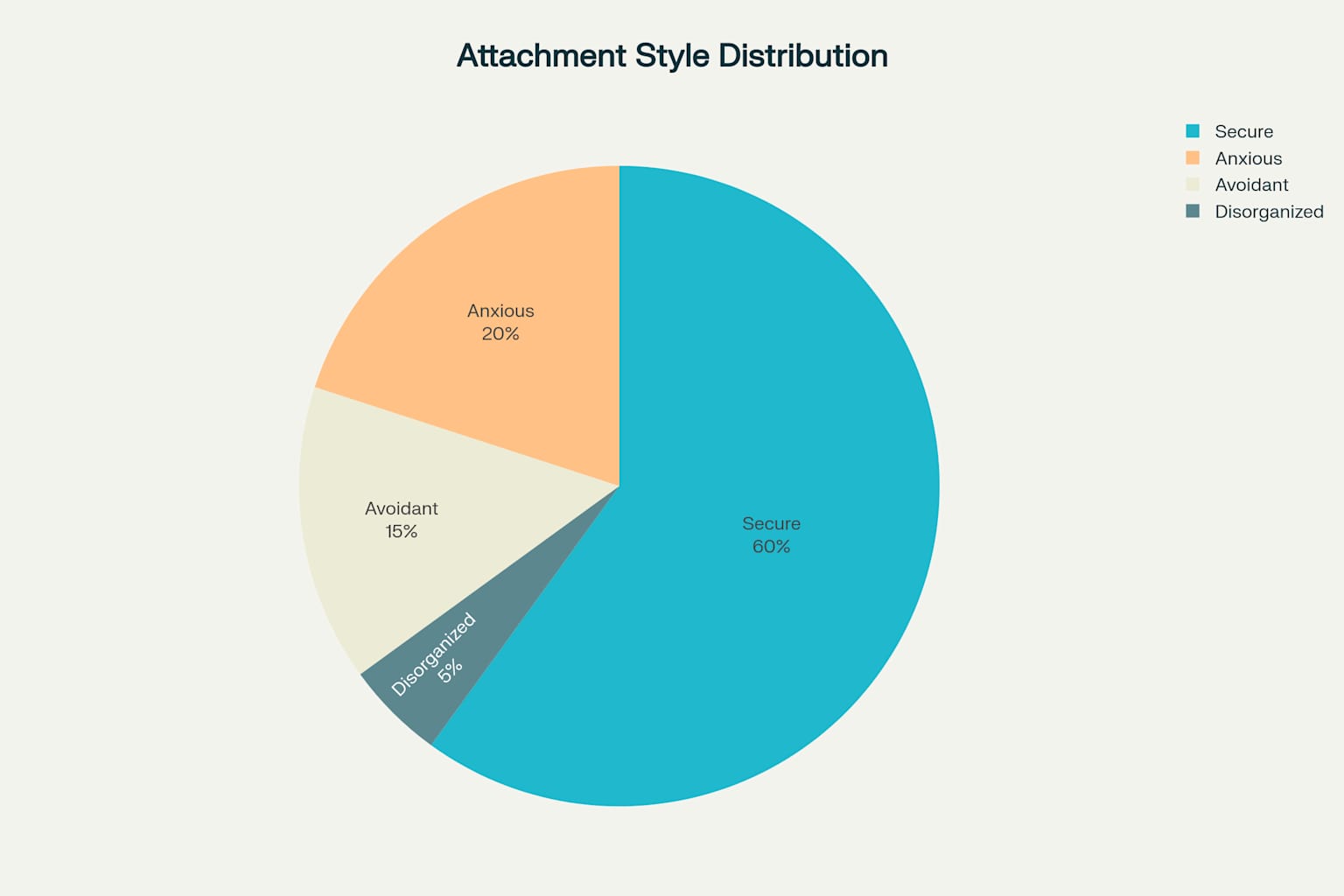
Attachment Styles Distribution in General Population
AI Detection Methods
AI systems can identify attachment styles through relationship pattern analysis and emotional expression parsing with 60-75% accuracy potential 37. Key indicators include relationship description patterns, emotional responses to separation and connection, trust and vulnerability expressions, conflict resolution approaches, and support-seeking behaviors 3839. The challenge lies in inferring early experiences from current behavioral patterns 40.
Multi-System Integration Framework
Parallel Processing Approach
Effective AI personality assessment requires simultaneous analysis through all five systems rather than sequential processing 3. This parallel approach allows for cross-validation between systems and identification of consistent patterns across different theoretical frameworks 4142. The integration framework weighs results based on data quality, system reliability, and confidence scores for each assessment 14.
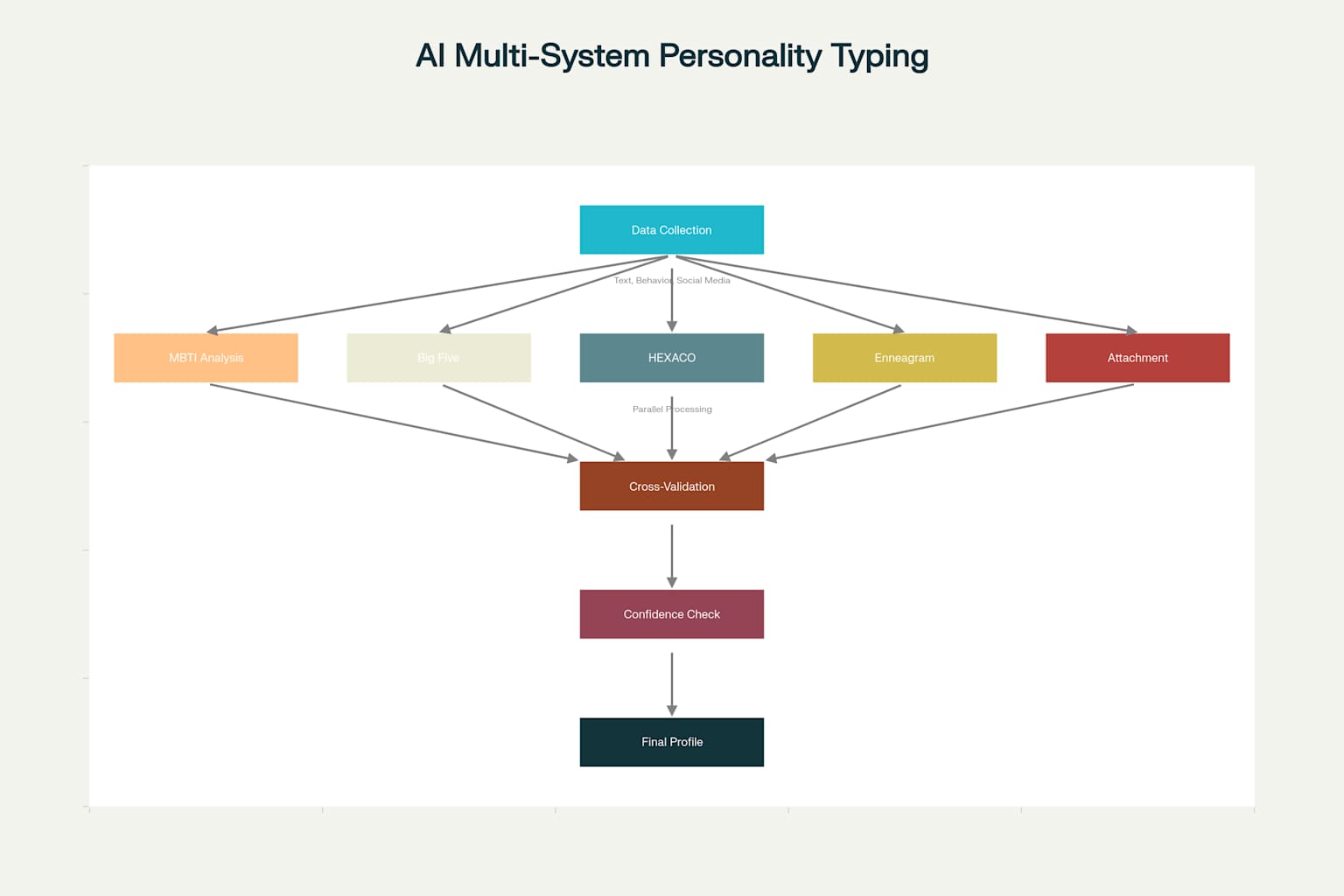
AI Multi-System Personality Typing Implementation Framework
Implementation Strategy
AI systems should employ a five-step process: Data Collection from diverse sources (text, behavior, social media), Multi-System Analysis running parallel algorithms, Integration and Validation cross-referencing results, Confidence Assessment providing uncertainty ranges, and Profile Generation offering nuanced insights 3. This approach balances accuracy with humility, acknowledging both capabilities and limitations 14.
Practical Applications and Ethical Considerations
Real-World Implementation
Modern AI personality assessment systems demonstrate significant potential, with some achieving up to 87% accuracy in predicting personality scores from social media analysis 14. These systems find applications in recruitment, personal development, team dynamics, and therapeutic contexts 4142. However, successful implementation requires addressing cultural bias, ensuring data privacy, and maintaining transparency in assessment methods 14.
Ethical Framework
Non-reductionist personality assessment demands strict ethical standards including explicit consent, privacy protection, transparency in methodology, acknowledgment of accuracy limitations, bias prevention, and professional oversight 3. AI systems must avoid perpetuating discrimination while providing actionable insights that respect human dignity and complexity 14. The framework emphasizes using personality insights for growth and transformation rather than static categorization or manipulation 1.
Conclusion
Non-reductionist personality typing integrates multiple validated systems to provide comprehensive, nuanced understanding of human personality while respecting its inherent complexity 21. This approach offers AI systems a robust framework for personality assessment that balances scientific rigor with ethical considerations 3. Success requires combining technical sophistication with philosophical wisdom, recognizing both the power and limitations of computational personality assessment 14. The ultimate goal is supporting human flourishing through deeper understanding while avoiding reductive categorization that diminishes human dignity 1.
The Enneagram Personality System: A Comprehensive Guide
Introduction and Core Foundation
The Enneagram is a sophisticated personality system that describes nine interconnected personality types, each driven by distinct core motivations, fears, and internal dynamics 434445. Unlike simpler categorization systems, the Enneagram focuses on the why behind human behavior rather than just observable traits, making it a powerful tool for understanding the unconscious patterns that drive our thoughts, feelings, and actions 4647.
Origins and Historical Development
The Enneagram has ancient roots spanning multiple wisdom traditions, with elements traceable to early Christian mystics like Evagrius Ponticus, who identified nine “deadly thoughts” in 4th-century Alexandria 43. The geometric symbol itself was introduced to the modern world by Greek-Armenian philosopher George Gurdjieff in the early 20th century, though he used it for different purposes than personality typing 4849.
The contemporary Enneagram of personality was primarily developed through the work of Bolivian philosopher Oscar Ichazo in the 1950s and Chilean psychiatrist Claudio Naranjo in the 1970s 434849. Ichazo founded the Arica Institute and coined the term “Enneagram of Personality,” while Naranjo integrated psychological concepts and brought the system to North America, where it gained widespread adoption 4849.
How the Enneagram Differs from Other Personality Systems
The Enneagram distinguishes itself from other personality frameworks in several fundamental ways 464750. While the Myers-Briggs Type Indicator (MBTI) focuses on cognitive preferences and information processing, and the Big Five measures trait levels, the Enneagram explores core emotional motivations and unconscious patterns 4647.
Key Differences:
- Motivation vs. Behavior: The Enneagram examines internal drives rather than external behaviors, recognizing that the same action can stem from entirely different motivations across types 4647
- Dynamic vs. Static: Unlike fixed trait models, the Enneagram describes a dynamic system where individuals move along different directions of health and integration 4551
- Depth of Analysis: The system incorporates multiple layers including centers of intelligence, wings, instinctual variants, and levels of development 4552
- Growth-Oriented: The Enneagram explicitly maps paths for psychological development and spiritual growth 5153
Theoretical Framework: Centers of Intelligence
The nine personality types are organized into three Centers of Intelligence, each associated with a core emotional theme and way of engaging with the world 455455.
Body/Gut Center (Types 8, 9, 1): These types are primarily concerned with control, autonomy, and resistance 45. Their core emotion is anger or rage, though each type handles this differently—Eights express it directly, Nines deny it, and Ones attempt to control it 45.
Heart/Feeling Center (Types 2, 3, 4): These types focus on image, identity, and emotional connection 4554. Their core emotion is shame, driving them to create and maintain specific self-images—Twos through being helpful, Threes through achieving success, and Fours through being unique 45.
Head/Thinking Center (Types 5, 6, 7): These types are oriented toward security, planning, and mental activity 4554. Their core emotion is fear or anxiety, leading them to different coping strategies—Fives withdraw, Sixes seek support, and Sevens escape into possibilities 45.
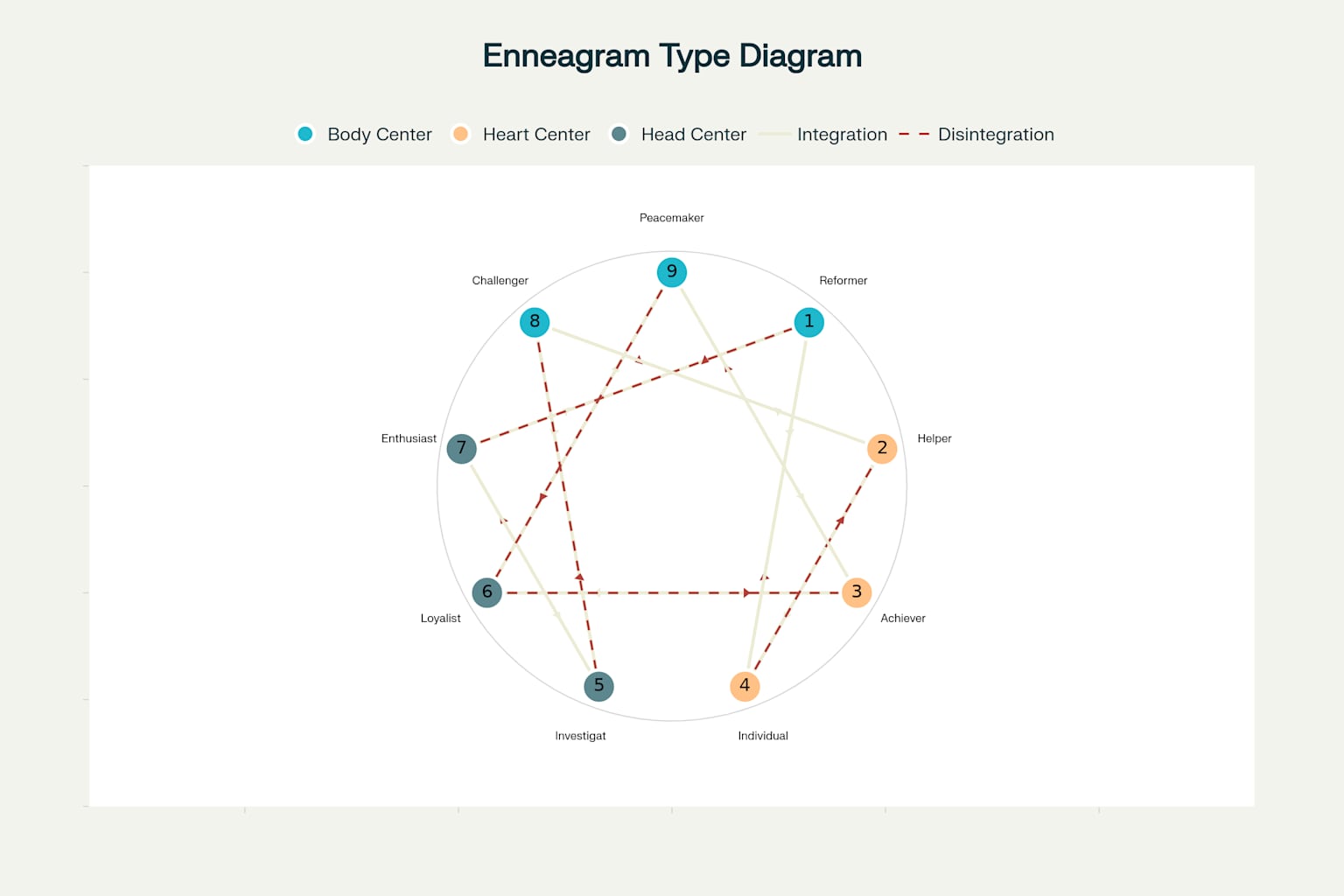
The Enneagram Symbol: Nine Personality Types and Their Interconnections
The Nine Personality Types
Each Enneagram type represents a complete worldview with distinct patterns of thinking, feeling, and behaving 5657. Understanding these types requires examining their core motivations, fears, and the unconscious strategies they use to navigate life 5859.
Type 1: The Reformer
Core Motivation: To be good, right, and perfect; to improve everything according to their ideals 5860. Core Fear: Being corrupt, evil, or defective; making mistakes that compromise their integrity 5861.
Type Ones are driven by an internal critic that constantly evaluates whether things meet their high standards 5860. They approach life with a sense of mission, believing they have a responsibility to make the world better 6062. In decision-making, Ones weigh options against their moral compass and principles, often struggling with the gap between how things are and how they should be 5863.
Strengths: Principled, hardworking, reliable, and detail-oriented with strong ethical foundations 5863. Challenges: Can become critical, resentful, inflexible, and perfectionist, especially when stressed 5860.
At their healthiest, Ones become wise, discerning, and nobly principled teachers who inspire others through their integrity 58. When unhealthy, they may become self-righteous, obsessive, and harshly critical of themselves and others 64.
Type 2: The Helper
Core Motivation: To be loved and needed; to feel worthy through helping others 6566. Core Fear: Being unworthy of love or unwanted; being rejected for their true self 6566.
Type Twos possess remarkable emotional intelligence and genuine care for others, but their helping often comes with unconscious strings attached 6566. They excel at reading emotional needs and positioning themselves as indispensable, but may neglect their own needs in the process 6566. Their decision-making is heavily influenced by how choices will affect their relationships and whether actions will generate appreciation 65.
Strengths: Empathetic, generous, warm, and skilled at building relationships 6566. Challenges: Can become manipulative, possessive, and self-neglecting, with difficulty expressing their own needs 6566.
Healthy Twos offer unconditional love and genuine service without expecting anything in return 65. Unhealthy Twos may become martyrlike, guilt-inducing, and emotionally manipulative 66.
Type 3: The Achiever
Core Motivation: To feel valuable and worthwhile; to be affirmed through success and admiration 6768. Core Fear: Being worthless without achievements; being exposed as a failure 6768.
Threes are highly adaptable performers who excel at reading what success looks like in any given context and reshaping themselves accordingly 67. They possess exceptional drive and efficiency but may lose touch with their authentic self in pursuit of external validation 6768. Their decisions are primarily driven by what will lead to success and positive recognition 67.
Strengths: Goal-oriented, confident, energetic, and inspiring leaders who motivate others toward achievement 67. Challenges: Can become deceptive, image-obsessed, and workaholic, struggling with authenticity 6768.
At their best, Threes become authentic, inspiring role models who help others achieve their potential 67. When unhealthy, they may become narcissistic, ruthlessly competitive, and disconnected from their true feelings 68.
Type 4: The Individualist
Core Motivation: To find themselves and their significance; to express their unique identity 596970. Core Fear: Having no identity or personal significance; being ordinary or insignificant 5971.
Fours live in a rich inner world of emotions and imagination, constantly seeking to understand their true self and place in the world 5970. They are drawn to beauty, depth, and meaning, but often feel that something essential is missing from their life 6970. Their decision-making is heavily influenced by their emotional state and desire for authenticity 5969.
Strengths: Creative, emotionally honest, empathetic, and capable of profound self-awareness 5970. Challenges: Can become moody, self-absorbed, envious, and prone to melancholy 5970.
Healthy Fours are inspired creators who help others connect with beauty and meaning 59. Unhealthy Fours may become self-pitying, withdrawn, and consumed by feelings of inadequacy 72.
Type 5: The Investigator
Core Motivation: To be capable and competent; to understand how the world works 7374. Core Fear: Being useless, helpless, or incapable; being overwhelmed by others’ demands 73.
Fives approach life as detached observers, preferring to understand rather than participate 7374. They conserve their energy carefully and value their independence above almost everything else 73. Their decision-making prioritizes maintaining autonomy and avoiding situations that might drain their resources 7374.
Strengths: Perceptive, innovative, objective, and capable of deep insight 7374. Challenges: Can become isolated, secretive, eccentric, and disconnected from their emotions 73.
At their best, Fives become visionary pioneers who contribute groundbreaking insights to the world 73. When unhealthy, they may become increasingly withdrawn, paranoid, and nihilistic 73.
Type 6: The Loyalist
Core Motivation: To have security and support; to feel safe and guided 757677. Core Fear: Being without support or guidance; facing uncertainty alone 767778.
Sixes are characterized by their relationship with authority and security, though this manifests in seemingly contradictory ways 7679. They may be either compliant and dutiful or rebellious and questioning, but both patterns stem from the same core anxiety about safety 7679. Their decision-making involves extensive analysis of potential risks and consequences 7577.
Strengths: Loyal, responsible, hardworking, and excellent at troubleshooting problems 7677. Challenges: Can become anxious, suspicious, defensive, and indecisive 7677.
Healthy Sixes are internally stable and courageously supportive of others 76. Unhealthy Sixes may become paranoid, self-doubting, and reactively aggressive 76.
Type 7: The Enthusiast
Core Motivation: To maintain happiness and satisfaction; to experience life fully 80. Core Fear: Being trapped in pain or deprivation; being limited or constrained 80.
Sevens approach life with infectious enthusiasm and an appetite for new experiences 80. They excel at generating possibilities and maintaining optimism, but may struggle with commitment and depth 80. Their decision-making is driven by what will provide the most stimulation and avoid potential pain 80.
Strengths: Optimistic, versatile, spontaneous, and skilled at inspiring others 80. Challenges: Can become scattered, impulsive, self-centered, and unable to tolerate difficulty 80.
At their best, Sevens achieve focused joy and deep satisfaction . When unhealthy, they become increasingly manic, escapist, and unable to tolerate any form of limitation 80.
Type 8: The Challenger
Core Motivation: To be self-reliant and in control of their own life; to resist weakness 81. Core Fear: Being controlled or violated by others; being vulnerable 81.
Eights are powerful, intense individuals who value strength and justice 81. They naturally take charge of situations and protect those they care about, but may struggle with vulnerability and gentleness 81. Their decision-making is driven by considerations of power, control, and protecting against perceived threats 81.
Strengths: Strong leaders, protective, decisive, and willing to fight for justice 81. Challenges: Can become dominating, confrontational, vengeful, and insensitive to others’ feelings 81.
Healthy Eights become generous protectors who use their strength to serve others 81. Unhealthy Eights may become destructive, ruthless, and tyrannical .
Type 9: The Peacemaker
Core Motivation: To maintain inner and outer peace; to avoid conflict and maintain harmony 8257. Core Fear: Loss of connection and fragmentation of self; conflict and separation 8257.
Nines are gentle, accepting individuals who can see multiple perspectives and bring people together 8257. They excel at creating harmony but may struggle with inertia and avoiding difficult decisions 8257. Their decision-making often involves postponing choices or going along with others to maintain peace 8257.
Strengths: Diplomatic, supportive, steady, and able to see all sides of an issue 8257. Challenges: Can become complacent, stubborn, passive-aggressive, and neglectful of their own needs 8257.
At their best, Nines become dynamic peacemakers who can heal conflicts and bring people together 57. When unhealthy, they may become completely withdrawn and disconnected from themselves and others 57.
System Mechanics
The Enneagram’s sophistication lies in its dynamic elements that show how personality patterns shift and change under different conditions 4553. These mechanics provide a roadmap for understanding both psychological deterioration and growth 5383.
Wings: Adjacent Type Influences
No one is a pure personality type—everyone is influenced by one or both of the types adjacent to their core type on the Enneagram circle 45. These wings add flavor and complexity to the basic type pattern 45.
For example, a Type 1 may have either a 9-wing (1w9) or a 2-wing (1w2) 45. A 1w9 tends to be more withdrawn and idealistic, while a 1w2 is more interpersonal and reform-minded 61. Most people have one dominant wing, though some may access both 45.
Wings provide important nuance in understanding how types manifest differently in different people 45. They can soften certain type patterns or intensify others, creating the 18 distinct wing combinations that add richness to the basic nine types 45.
Directions of Integration and Disintegration
Each type has specific pathways showing how they change under stress (disintegration) and growth (integration) 458451. These arrows connect each type to two others, creating a dynamic map of psychological movement 45.
Integration Directions (Growth): When moving toward health, each type takes on the positive qualities of another type 4551. For example, Ones integrate to Seven, becoming more spontaneous and joyful; Twos integrate to Four, becoming more self-aware and authentic 45.
Disintegration Directions (Stress): Under stress, each type may exhibit the negative qualities of another type 4584. Stressed Ones go to Four, becoming moody and self-critical; stressed Twos go to Eight, becoming demanding and controlling 45.
Understanding these directions helps explain why people sometimes seem “not like their type”—they may be operating from their stress or growth direction 8485. The goal is to consciously access integration qualities while recognizing and managing disintegration patterns 4551.
Instinctual Variants: The Three Drives
Beyond core type, every person has three basic instinctual drives that influence how their type manifests 455286. These instinctual variants create 27 distinct subtypes when combined with the nine basic types 86.
Self-Preservation (SP): Focus on physical safety, comfort, health, and resources 455286. SP types are concerned with having enough—enough food, money, security, and energy to meet life’s demands 4586.
Social (SO): Focus on group dynamics, belonging, and social hierarchy 455286. SO types are attuned to their position in groups and how to contribute to collective welfare 4586.
Sexual/One-to-One (SX): Focus on intensity, chemistry, and personal connection 455286. SX types seek stimulating, charged interactions and may be the most emotionally intense of the three variants 4586.
Most people have one dominant instinct, a supporting secondary instinct, and a “blind spot” third instinct that they tend to neglect 86. This creates an instinctual stack that significantly influences personality expression 86.
Levels of Development: The Health Continuum
Perhaps the most important insight of the Enneagram is that each type exists on a continuum of psychological health 455383. The Levels of Development describe nine levels of functioning within each type 4553.
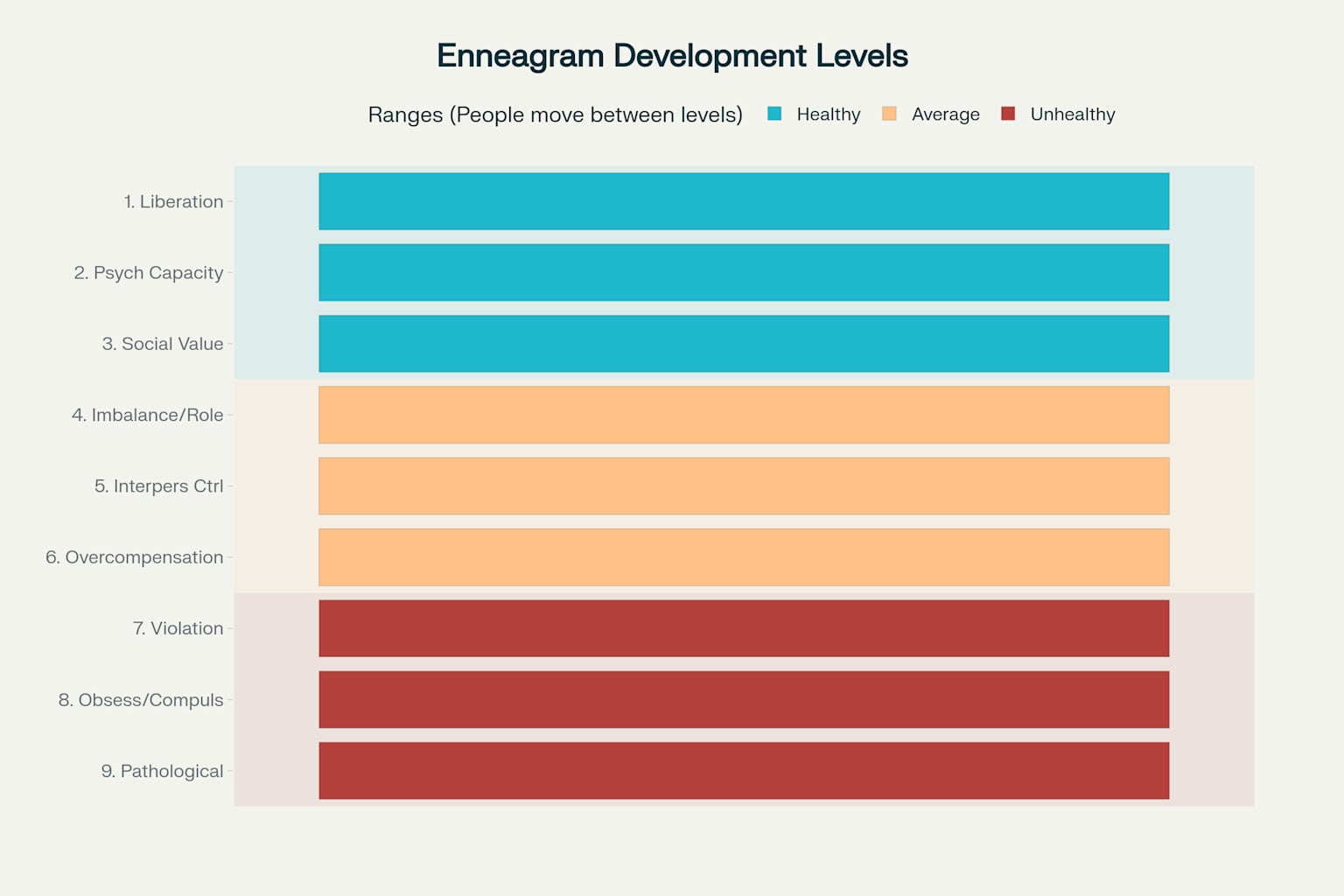
The Nine Levels of Development: Understanding Psychological Health in the Enneagram
Healthy Levels (1-3): Individuals operate with increasing freedom from ego identification 5383. They can access their type’s gifts without being trapped by its limitations 53.
Average Levels (4-6): Most people operate primarily in this range 5383. Ego patterns are more fixed, and defensive strategies become more prominent 53.
Unhealthy Levels (7-9): Individuals become increasingly trapped by their type’s compulsions 5383. Destructive patterns dominate, and contact with reality may be significantly impaired 53.
The levels help explain why two people of the same type can seem very different—they may be operating at different levels of health 53. Understanding levels also provides a roadmap for growth, as individuals can work to move up the continuum toward greater psychological freedom 5383.
Practical Applications
Identifying Your Own Type
Finding your correct Enneagram type requires honest self-reflection and attention to internal motivations rather than external behaviors 878889. The process involves examining core fears, desires, and childhood patterns 87.
Important Principles for Self-Typing:
- Focus on motivations, not behaviors—ask “why” you do things, not just “what” you do 8789
- Consider your patterns over time, not just current circumstances 8990
- Be honest about your internal experience, including aspects you might prefer to hide 87
- Take time with the process—accurate typing often requires weeks or months of observation 89
Common Mistyping Pitfalls:
- Wishful typing: Choosing a type you aspire to be rather than recognizing current patterns 8990
- Behavioral focus: Typing based on actions rather than underlying motivations 9190
- Stress confusion: Mistyping based on stress behaviors rather than core patterns 9290
- Social desirability: Avoiding types that seem less flattering 8889
Common Misconceptions
Several widespread misconceptions can interfere with accurate understanding and application of the Enneagram 889189.
“You Can Type Others”: One of the most important principles is that only individuals can determine their own type 8889. While external observations can provide input, typing requires access to internal motivations that only the person themselves can know 8889.
“Wings Can Be Any Number”: Wings must be adjacent to your core type—you cannot be a 4w8, for example 88. This misconception stems from confusing wings with integration/disintegration directions 88.
“Types Are Fixed Boxes”: The Enneagram describes dynamic patterns, not static categories 9193. People constantly move between different levels of health and may access various directions throughout their lives 91.
“Some Types Are Better Than Others”: Each type has both gifts and limitations 91. No type is inherently superior, and each makes unique contributions when healthy 4591.
Personal Development Applications
The Enneagram’s primary value lies in its capacity to foster genuine self-awareness and psychological growth 9394. By understanding their type’s patterns, individuals can:
Recognize Automatic Patterns: Becoming aware of habitual thoughts, emotions, and behaviors allows for conscious choice rather than unconscious reaction 9394.
Work with Core Issues: Each type has specific areas for development—Ones learning self-compassion, Twos practicing self-care, Threes developing authenticity 586567.
Access Integration: Understanding integration directions provides specific pathways for growth 5193.
Navigate Stress: Recognizing disintegration patterns helps individuals catch themselves before falling into destructive cycles 8493.
Relationship Dynamics
The Enneagram provides powerful insights for understanding relationship patterns and improving communication 9596. Different types have different styles of relating, communicating, and handling conflict 9596.
Communication Adaptations: Understanding someone’s type helps tailor communication style—being direct with Eights, patient with Nines, appreciative with Twos 95. Conflict Resolution: Different types experience and handle conflict differently—Ones want fairness, Sixes want security, Sevens want options 9596.
Complementary Patterns: Some type combinations naturally complement each other, while others may create predictable friction 95. Understanding these dynamics helps couples and families navigate relationships more skillfully 95.
Workplace Applications
Organizations increasingly use the Enneagram for team development, leadership training, and conflict resolution 979895. The system helps teams understand diverse working styles and leverage individual strengths 9798.
Team Dynamics: Understanding type distribution helps teams identify potential blind spots and leverage diverse perspectives 9798. Leadership Development: The Enneagram helps leaders understand their natural style and develop flexibility in working with different types 9795.
Communication Enhancement: Teams can improve collaboration by adapting communication styles to match different types’ preferences and needs 979596.
Performance Optimization: Understanding what motivates different types helps managers provide appropriate feedback, recognition, and development opportunities 9798.
Conclusion
The Enneagram offers a sophisticated framework for understanding human personality that goes far beyond simple categorization 4345. By focusing on core motivations rather than surface behaviors, it provides insights into the unconscious patterns that drive human experience 4647.
What makes the Enneagram particularly valuable is its integration of multiple dimensions—core type, wings, instinctual variants, levels of development, and integration directions—creating a nuanced portrait of individual psychology 458653. This complexity allows for both precision in understanding specific patterns and flexibility in recognizing the full range of human expression 45.
The system’s emphasis on growth and development distinguishes it from static personality models 5193. Rather than simply describing what is, the Enneagram provides a roadmap for what could be, offering specific pathways for psychological development and spiritual growth 515394.
Whether used for personal development, relationship enhancement, or organizational effectiveness, the Enneagram serves as a powerful tool for increasing self-awareness and understanding others 939594. Its ultimate goal is not to limit people with labels, but to free them from unconscious patterns and help them access their full human potential 5393.
The journey of working with the Enneagram is itself transformative 9394. As individuals deepen their understanding of their type, they often discover not just who they are, but who they can become 5153. In this way, the Enneagram serves not just as a personality system, but as a map for the ongoing process of human development and self-realization 495194.
The Myers-Briggs Type Indicator (MBTI): A Comprehensive Guide
The Myers-Briggs Type Indicator represents one of the most widely used personality assessment tools in the world, with over two million people completing it annually 99. This comprehensive system offers insights into how individuals perceive information, make decisions, and interact with the world around them 100. While popular in workplace and personal development settings, MBTI also faces significant scientific scrutiny that users must understand to apply it responsibly 101.
Historical Foundation
Origins and Development
The MBTI story begins with Katharine Cook Briggs, an intellectually curious woman who first became interested in personality differences when she met her daughter’s future husband, Clarence Myers 99102. Briggs noticed marked differences between his personality and that of other family members, inspiring her to embark on extensive research into human temperaments in 1917 101. Initially, she developed her own typology with four temperaments: meditative, spontaneous, executive, and social 101.
Isabel Briggs Myers, Katharine’s daughter, became fascinated by personality theory, particularly the concept of introversion, and typed herself as an INFP 101103. The mother-daughter team was driven by a powerful vision: if people understood each other better, they could work together more effectively and create less conflict in the post-World War II world 99. This humanitarian motivation drove Isabel to dedicate the rest of her life to developing what would become the MBTI 99.
Connection to Carl Jung’s Theory
The transformational moment came in 1923 when Briggs read the English translation of Carl Jung’s “Psychological Types” 101104. Jung’s work, originally published in German in 1921, provided a sophisticated theoretical framework that went far beyond Briggs’s initial four-type system 100104. Jung had identified eight personality types based on two primary attitudes (Extraversion and Introversion) and four cognitive functions (Thinking, Feeling, Sensing, and Intuition) 104105.
Briggs recognized that Jung’s theory resembled but significantly expanded her own work 101. Jung’s approach focused on how individuals perceive information and make decisions through different mental processes, viewing these as dynamic rather than static characteristics 106. However, Jung never intended his work as a rigid categorization system but rather as a developmental tool reflecting the interplay between conscious and unconscious mind 106.
Evolution from Theory to Practice
Myers and Briggs made several crucial modifications to Jung’s original theory to create a practical assessment tool 100101. Most significantly, they added the Judging-Perceiving dichotomy, which Jung had not explicitly included, to identify the dynamic character of each type and determine which function individuals extravert to the outside world 100. This addition allowed them to create a systematic method for identifying personality types through questionnaire responses 107.
The first versions of the MBTI instrument were published in 1943, with three major manual revisions occurring in 1962, 1985, and 1998 100. Isabel Myers spent over 20 years developing questions and validating the instrument, driven by her belief that understanding personality differences could help people find more suitable careers and work more effectively together 99103. The assessment evolved from a simple personality sorting tool into a comprehensive framework for understanding human behavior and preferences 108.
Current Scientific Standing and Criticisms
The MBTI’s scientific validity remains highly contested within the psychological community 101109. Critics argue that the assessment has been “widely regarded as pseudoscience” and called “one of the worst personality tests in existence” 101. Psychologist Adam Grant famously termed it “the fad that won’t die,” while others have compared it to “an elaborate Chinese fortune cookie” 101.
Key scientific concerns include:
- Limited empirical support: A 1991 National Academy of Sciences review found that only the Extraversion-Introversion scale showed strong validity, while other scales demonstrated relatively weak validity 101
- Binary categorization problems: Research shows personality traits exist on continuous distributions rather than discrete either-or categories 109
- Test-retest reliability issues: Studies suggest significant numbers of people receive different results when retaking the assessment 101
- Lack of predictive validity: The assessment shows minimal correlation with actual job performance despite being used for career guidance 101
However, defenders note that much criticism stems from misapplication of the tool rather than fundamental flaws in the underlying theory 110111. The Myers & Briggs Foundation emphasizes that MBTI describes preferences and tendencies rather than abilities or fixed characteristics 111.
Core Framework: The Four Dichotomies
The MBTI system rests on four fundamental preference pairs that reflect different aspects of personality 100112. Understanding these dichotomies provides the foundation for comprehending how the 16 types emerge and interact 113.
Extraversion (E) vs. Introversion (I): Energy Orientation
This dichotomy, first explored by Jung, describes how individuals direct their energy and where they naturally focus their attention 112. Contrary to popular misconceptions, this preference is not simply about being outgoing or shy 112.
Extraversion (E) involves directing energy primarily toward the outer world of activities and people 100112. Extraverts tend to:
- Think out loud and process ideas through discussion
- Gain energy from social interaction and external stimulation
- Prefer breadth of experience over depth
- Act first, then reflect
- Feel energized by group activities and meetings
Introversion (I) involves directing energy primarily toward the inner world of ideas, concepts, and internal experience 100112. Introverts tend to:
- Think internally before speaking
- Gain energy from solitude and quiet reflection
- Prefer depth of experience over breadth
- Reflect first, then act
- Feel drained by extensive social interaction
Real-world example: In a team meeting, an Extravert might immediately voice ideas as they think of them, building energy from the group discussion. An Introvert might prefer to listen, process internally, and contribute more thoughtfully after having time to reflect 107.
Sensing (S) vs. Intuition (N): Information Processing
This dichotomy describes how individuals prefer to take in and process information from their environment 112113.
Sensing (S) involves focusing on concrete, observable information gathered through the five senses 100112. Sensing types tend to:
- Trust facts, details, and past experience
- Focus on present realities and practical applications
- Prefer step-by-step, sequential approaches
- Value precision and accuracy
- Learn best through hands-on experience
Intuition (N) involves focusing on patterns, possibilities, and future implications 100112. Intuitive types tend to:
- Trust insights, hunches, and future possibilities
- Focus on the big picture and conceptual frameworks
- Prefer to jump around between ideas
- Value innovation and creativity
- Learn best through theoretical exploration
Real-world example: When planning a vacation, a Sensing type might research specific hotels, read detailed reviews, and create detailed itineraries. An Intuitive type might focus on the overall experience, potential adventures, and leave room for spontaneous discoveries 114.
Thinking (T) vs. Feeling (F): Decision-Making Criteria
This dichotomy reveals how individuals prefer to make judgments and decisions 112113.
Thinking (T) involves making decisions based on logical analysis and objective criteria 100112. Thinking types tend to:
- Prioritize logic, consistency, and fairness
- Focus on cause-and-effect relationships
- Make decisions impersonally
- Value competence and achievement
- Provide direct, honest feedback
Feeling (F) involves making decisions based on personal values and consideration of people 100112. Feeling types tend to:
- Prioritize harmony, values, and individual needs
- Focus on human impact and relationships
- Make decisions considering personal implications
- Value cooperation and appreciation
- Provide supportive, encouraging feedback
Real-world example: When implementing budget cuts, a Thinking type might focus on data-driven decisions about efficiency and cost-effectiveness. A Feeling type might prioritize minimizing human impact and maintaining team morale during difficult changes 115.
Judging (J) vs. Perceiving (P): Lifestyle Orientation
This dichotomy, added by Myers and Briggs, describes how individuals prefer to approach the external world and organize their lives 100116.
Judging (J) involves preferring structure, closure, and organized approaches to the external world 100116. Judging types tend to:
- Prefer planned, organized environments
- Feel comfortable when decisions are made
- Work steadily toward deadlines
- Value predictability and control
- Focus on task completion
Perceiving (P) involves preferring flexibility, openness, and adaptable approaches to the external world 100116. Perceiving types tend to:
- Prefer flexible, adaptable environments
- Feel comfortable keeping options open
- Work in bursts, often close to deadlines
- Value spontaneity and freedom
- Focus on gathering more information
Real-world example: A Judging type might plan their weekend activities in advance, make reservations, and feel satisfied when everything goes according to plan. A Perceiving type might prefer to see what opportunities arise, remaining open to last-minute changes and spontaneous activities 117.
The 16 Personality Types
The combination of preferences across all four dichotomies creates 16 distinct personality types, each with unique characteristics, strengths, and potential challenges 118. These types are often organized into four temperament groups that share similar core motivations and behaviors 119.
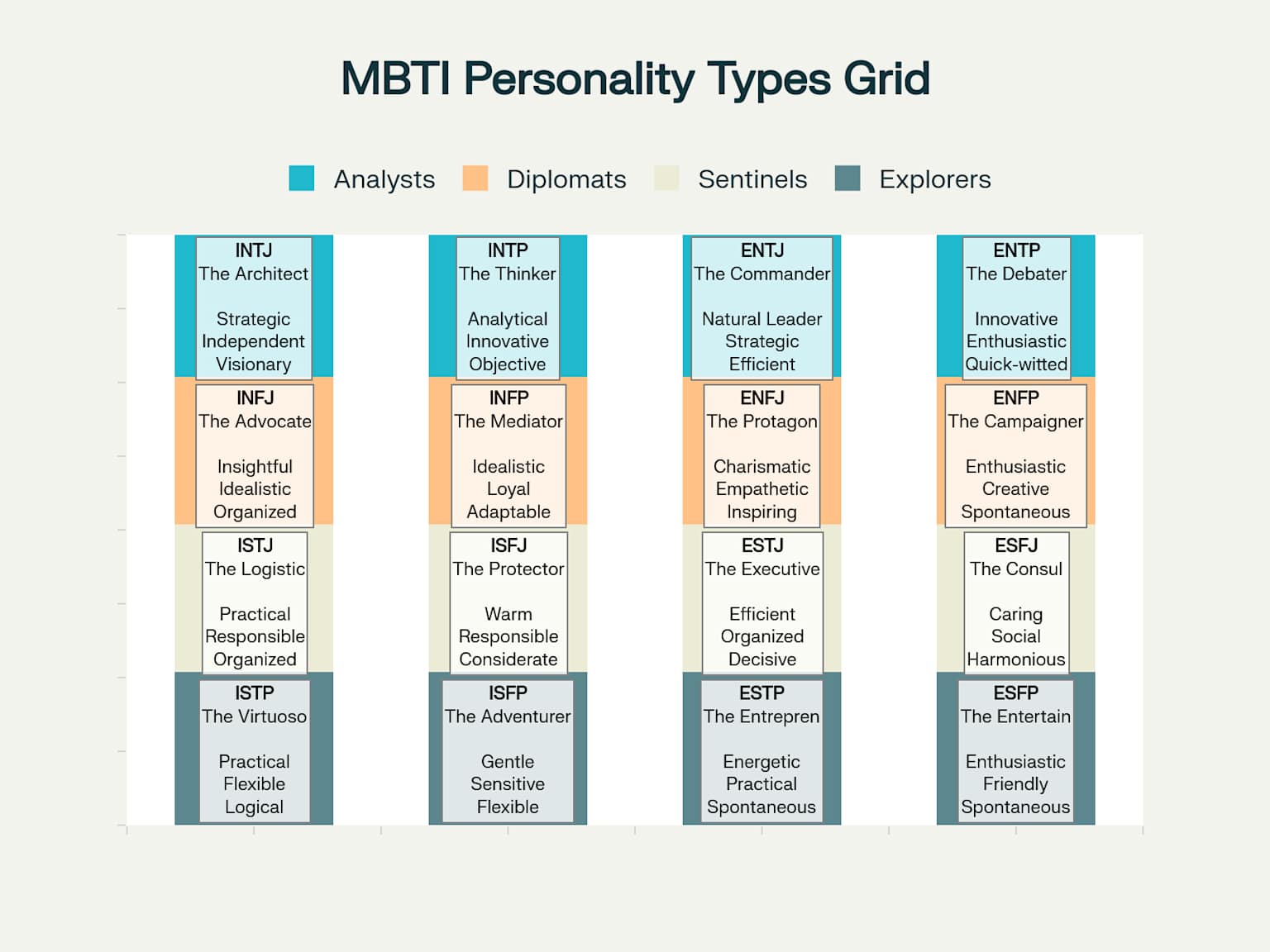
The 16 MBTI Personality Types organized by temperament groups showing each type’s nickname and key characteristics
The Analysts (NT Types)
INTJ - The Architect: Combines strategic thinking with independence and long-term vision 118. These individuals excel at seeing patterns in complex systems and developing comprehensive plans for improvement. Their dominant Introverted Intuition (Ni) helps them synthesize information into insights, while auxiliary Extraverted Thinking (Te) enables systematic implementation 120. Common careers include strategy, engineering, and research management. INTJs can struggle with micromanagement and prefer working independently toward long-term goals 121122.
INTP - The Thinker: Characterized by analytical precision and theoretical innovation 118. They possess unusual ability to focus deeply on problems within their areas of interest, driven by dominant Introverted Thinking (Ti) for logical analysis and auxiliary Extraverted Intuition (Ne) for exploring possibilities 123120. Career paths often include research, academia, and systems analysis. INTPs may struggle with routine tasks and prefer environments that encourage intellectual exploration 121122.
ENTJ - The Commander: Natural leaders who quickly identify inefficiencies and develop systematic solutions 118. Their dominant Extraverted Thinking (Te) drives organizational ability, while auxiliary Introverted Intuition (Ni) provides strategic insight 120. They excel in executive roles, business leadership, and complex project management. ENTJs can become impatient with inefficiency and may need to develop sensitivity to others’ feelings 121122.
ENTP - The Debater: Innovative and adaptable individuals who excel at generating and analyzing conceptual possibilities 118. Dominant Extraverted Intuition (Ne) fuels their creativity and adaptability, while auxiliary Introverted Thinking (Ti) provides analytical framework 120. They thrive in consulting, entrepreneurship, and innovation roles but may struggle with routine implementation and follow-through 121122.
The Diplomats (NF Types)
INFJ - The Advocate: Insightful individuals who seek meaning and connection in all aspects of life 118. Their dominant Introverted Intuition (Ni) creates deep insights about people and situations, while auxiliary Extraverted Feeling (Fe) drives their desire to help others reach their potential 120. Common career paths include counseling, writing, and human services. INFJs need time alone to process and can become overwhelmed by too much external stimulation 124.
INFP - The Mediator: Idealistic individuals deeply committed to their personal values and the people important to them 118. Dominant Introverted Feeling (Fi) creates strong personal values and authenticity, while auxiliary Extraverted Intuition (Ne) explores possibilities for expressing those values 125. They excel in creative arts, counseling, and human services but may struggle with highly structured environments 124.
ENFJ - The Protagonist: Charismatic leaders who inspire others toward personal growth and positive change 118. Their dominant Extraverted Feeling (Fe) creates natural teaching and mentoring abilities, while auxiliary Introverted Intuition (Ni) provides insight into human potential 120. Career paths often include education, counseling, and organizational leadership. ENFJs may neglect their own needs while focusing on helping others 126.
ENFP - The Campaigner: Enthusiastic individuals who see life as full of exciting possibilities and connections 118. Dominant Extraverted Intuition (Ne) drives their enthusiasm for new ideas and people, while auxiliary Introverted Feeling (Fi) provides value-based decision making 120. They thrive in marketing, journalism, and creative fields but may struggle with routine tasks and administrative details 124.
The Sentinels (SJ Types)
ISTJ - The Logistician: Dependable individuals who earn success through thoroughness and reliability 118. Their dominant Introverted Sensing (Si) creates attention to detail and respect for proven methods, while auxiliary Extraverted Thinking (Te) provides organizational structure 120. Common careers include accounting, administration, and law enforcement. ISTJs prefer clear expectations and may resist unnecessary change 127128.
ISFJ - The Protector: Caring individuals committed to meeting their obligations and helping others 118. Dominant Introverted Sensing (Si) creates awareness of others’ needs and attention to detail, while auxiliary Extraverted Feeling (Fe) drives their service orientation 120. Career paths often include healthcare, education, and social services. ISFJs may neglect their own needs while caring for others 127128.
ESTJ - The Executive: Practical leaders who focus on getting results efficiently 118. Their dominant Extraverted Thinking (Te) creates natural organizational and leadership abilities, while auxiliary Introverted Sensing (Si) provides respect for established procedures 120. They excel in management, sales, and administrative roles but may struggle with ambiguous situations 127128.
ESFJ - The Consul: Warm individuals who work to establish harmony and meet others’ needs 118. Dominant Extraverted Feeling (Fe) drives their people-focused approach, while auxiliary Introverted Sensing (Si) creates attention to others’ preferences and traditions 120. Common careers include healthcare, education, and customer service. ESFJs may avoid conflict and struggle with impersonal criticism 128.
The Explorers (SP Types)
ISTP - The Virtuoso: Practical problem-solvers who value efficiency and hands-on learning 118. Their dominant Introverted Thinking (Ti) creates logical analysis of how things work, while auxiliary Extraverted Sensing (Se) provides adaptability and practical skills 120. Career paths often include engineering, crafts, and emergency services. ISTPs prefer independence and may resist micromanagement 121128.
ISFP - The Adventurer: Gentle individuals who value harmony and personal authenticity 118. Dominant Introverted Feeling (Fi) creates strong personal values and empathy, while auxiliary Extraverted Sensing (Se) provides adaptability and aesthetic appreciation 120. They excel in arts, healthcare, and counseling but may struggle with conflict and criticism 121128.
ESTP - The Entrepreneur: Energetic individuals who focus on immediate results and practical problem-solving 118. Their dominant Extraverted Sensing (Se) creates adaptability and action orientation, while auxiliary Introverted Thinking (Ti) provides logical analysis 120. Common careers include sales, entertainment, and emergency services. ESTPs may struggle with long-term planning and theoretical concepts 121128.
ESFP - The Entertainer: Enthusiastic individuals who bring warmth and spontaneity to their interactions 118. Dominant Extraverted Sensing (Se) drives their adaptability and people focus, while auxiliary Introverted Feeling (Fi) provides empathy and value-based decisions 120. Career paths often include entertainment, healthcare, and hospitality. ESFPs may avoid conflict and struggle with impersonal analysis 121128.
Cognitive Functions Deep Dive
Understanding Cognitive Functions
Cognitive functions represent the mental processes underlying personality types, providing much deeper insight than the four-letter codes alone 105129. While the letters indicate preferences, cognitive functions explain how these preferences actually operate in the mind 130129. Isabel Myers expanded Jung’s original four functions into eight by adding extraverted and introverted orientations for each 129105.
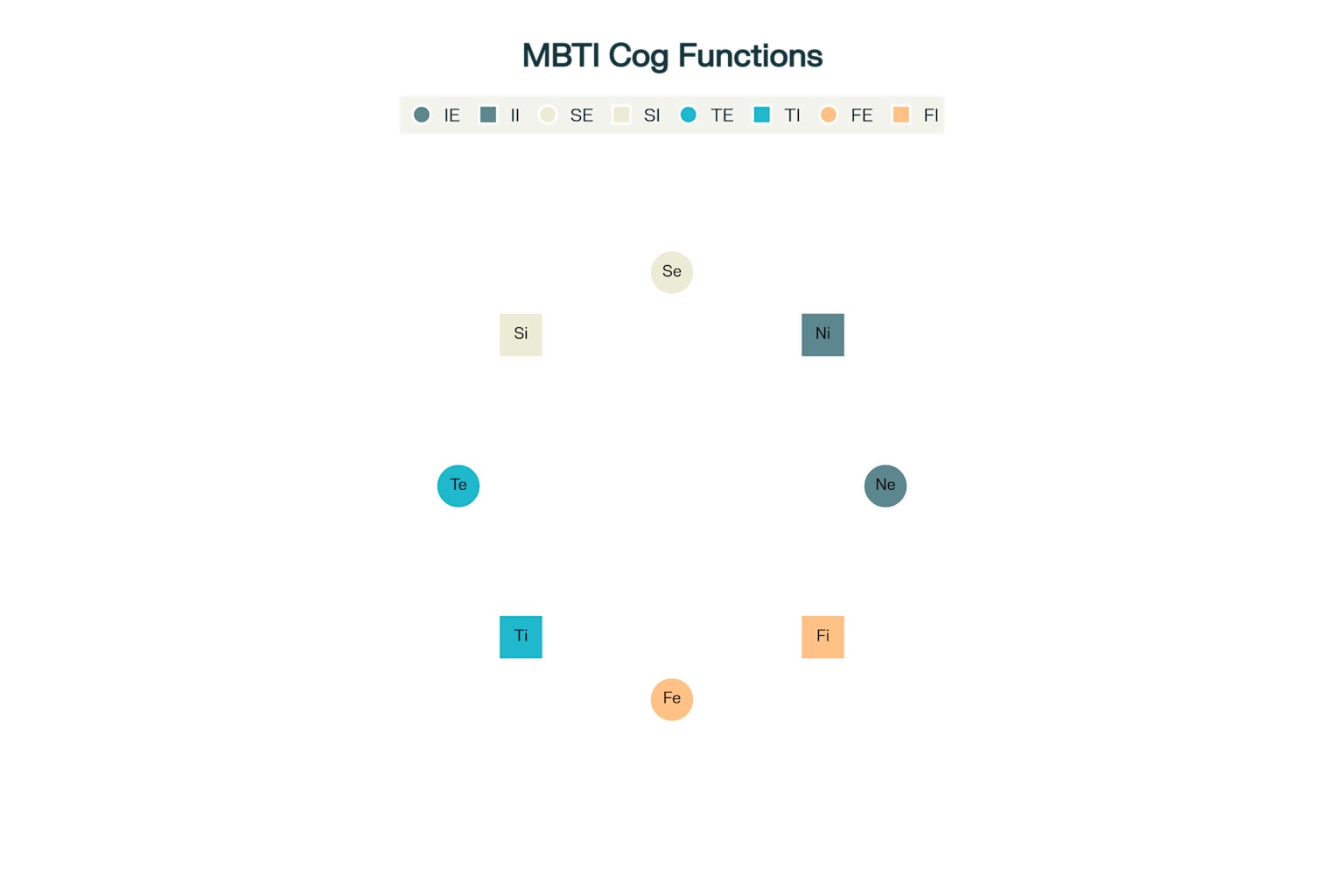
The 8 MBTI Cognitive Functions showing their names, codes, and descriptions with type and orientation distinctions
The Eight Cognitive Functions
Extraverted Functions express themselves through engagement with the external world, while Introverted Functions operate primarily in the internal mental landscape 129131. Each function serves different purposes in how we perceive information and make decisions 105.
Perceiving Functions (Information Gathering):
- Extraverted Sensing (Se): Lives in the present moment, seeks sensory experiences, adapts quickly to changing circumstances 132
- Introverted Sensing (Si): Recalls past experiences, compares current situations to stored memories, values stability and tradition 132
- Extraverted Intuition (Ne): Explores possibilities, sees patterns and connections, generates new ideas and alternatives 133129
- Introverted Intuition (Ni): Synthesizes information into insights, predicts future outcomes, sees the essential core of situations 133132
Judging Functions (Decision Making):
- Extraverted Thinking (Te): Organizes the external world, implements systems and structures, seeks efficiency and results 131
- Introverted Thinking (Ti): Analyzes logical consistency, builds internal frameworks, seeks precision and understanding 133123
- Extraverted Feeling (Fe): Harmonizes with others, considers group needs and social dynamics, expresses emotions 133131
- Introverted Feeling (Fi): Maintains personal values, seeks authenticity, protects individual dignity and worth 133125
Function Stack Theory
Every personality type uses four cognitive functions arranged in a specific hierarchy of strength and consciousness 130131. This function stack explains why individuals of the same type can appear different while sharing fundamental patterns 134.
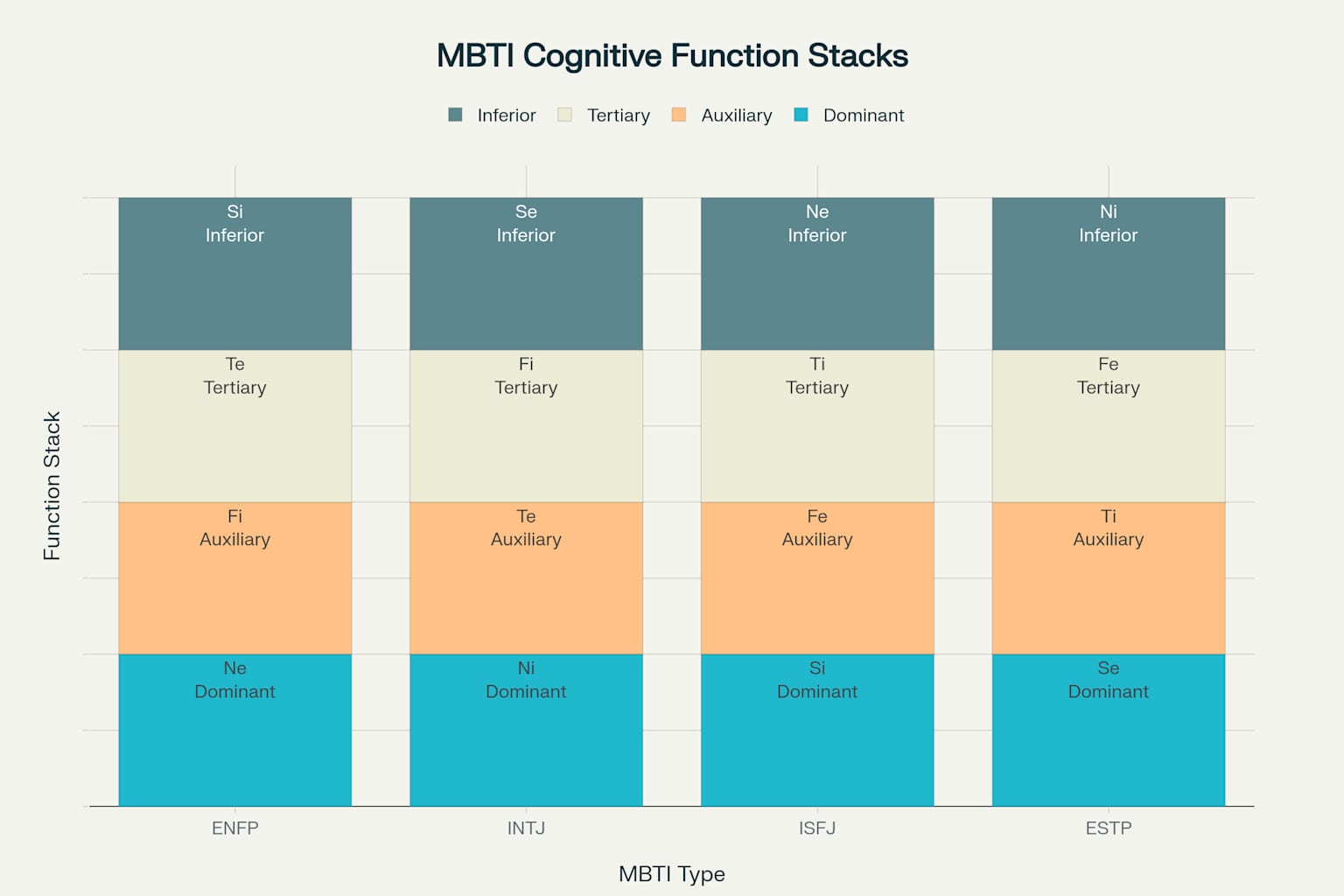
Cognitive Function Stacks for four representative MBTI types showing the hierarchy from dominant to inferior functions
Dominant Function: The most developed and conscious function, representing the core strength of each type 130131. This function feels most natural and energizing to use, though overreliance can create imbalance 131. For example, an ENFP’s dominant Extraverted Intuition drives their enthusiasm for possibilities and new ideas 125.
Auxiliary Function: The supporting function that provides balance to the dominant 130131. It operates in the opposite attitude (extraversion/introversion) from the dominant, ensuring types can both introvert and extravert appropriately 131. The auxiliary typically develops during adolescence and early adulthood 135.
Tertiary Function: The third function remains relatively unconscious and undifferentiated 130131. It often emerges more prominently during midlife development as individuals seek growth beyond their comfort zones 131. This function can appear during stress in immature or one-dimensional ways 136.
Inferior Function: The least conscious and developed function, representing the opposite of the dominant 130131. While weakest, it plays crucial roles in stress responses and long-term development 131. Under severe stress, the inferior function may “grip” the personality, causing uncharacteristic behavior 131.
Developmental Patterns Throughout Life
Type development follows predictable patterns across the lifespan, beginning with establishing the dominant function in childhood and continuing throughout life 135131. Environmental factors significantly influence whether natural preferences are nurtured or suppressed 135.
Early Development (Childhood to Early Adulthood): Focus on developing confidence with the dominant and auxiliary functions 135131. Supportive environments allow natural preferences to emerge, while unsupportive environments may force premature development of non-preferred functions 135.
Midlife Development (30s-50s): Natural attention turns toward developing tertiary and inferior functions 131. This period often involves questioning established patterns and exploring previously avoided areas 131. For example, a dominant Thinking type might become more interested in relationships and emotional expression 131.
Later Development (50s and beyond): Integration of all functions becomes possible, leading to greater flexibility and wisdom 135. Individuals can access their full range of mental processes while maintaining their core type identity 131.
Why Same Types Appear Different
Several factors explain why two people with identical four-letter types can seem remarkably different 134131:
Function Development Levels: Individuals vary in how well they’ve developed each function in their stack 134. One ENFP might have well-developed auxiliary Fi (values clarity), while another relies almost exclusively on dominant Ne (endless possibility exploration) 125.
Environmental Influences: Cultural expectations, family dynamics, and life experiences shape how functions manifest 135134. An INTJ raised in a highly social environment might develop stronger Fe (people skills) than typical for their type 134.
Stress and Health Levels: Chronic stress can cause people to operate from their inferior function, appearing very different from their natural type 134131. Healthy individuals access their full function stack more effectively than those experiencing significant stress 134.
Subtype Variations: Some systems recognize subtypes within each MBTI type based on which auxiliary function is more developed or environmental influences 134.
Practical Applications
Accurately Determining Your Type
Self-typing requires honest introspection about internal motivations rather than surface behaviors 111134. The MBTI measures preferences - natural inclinations rather than abilities or learned skills 111.
Essential Principles for Accurate Typing:
- Focus on how you prefer to operate, not how well you perform different functions 111
- Consider your natural state when relaxed and unstressed, not crisis behaviors 134
- Examine patterns over time rather than temporary circumstances 111
- Look at underlying motivations, not just external actions 134
Common Mistyping Issues:
Wishful Typing: Choosing a type that seems more desirable rather than recognizing actual patterns 134. Many people want to see themselves as Intuitive rather than Sensing, or as Thinking rather than Feeling, based on cultural biases 134.
Situational Confusion: Typing based on work roles or temporary life circumstances 134. Someone might appear Extraverted in their sales job while actually being naturally Introverted 111.
Stress Response Misidentification: Mistaking inferior function “grip” experiences for natural type 134. A stressed INFP might appear very Te-focused (critical, controlling) but this represents dysfunction, not type 134.
Social Desirability Bias: Unconsciously answering questions based on what seems socially acceptable rather than personal truth 101111.
MBTI in Workplace Teams and Communication
Understanding type differences can dramatically improve team effectiveness and communication 137138. Research shows that teams with type awareness experience better collaboration, reduced conflict, and improved performance 107139.
Communication Adaptations by Type:
- With Extraverts: Think out loud, engage in discussion, provide immediate feedback 138
- With Introverts: Allow processing time, communicate in writing when possible, respect need for quiet 138
- With Sensors: Provide specific details, practical examples, step-by-step instructions 138
- With Intuitives: Focus on big picture, implications, creative possibilities 138
- With Thinkers: Present logical reasoning, objective analysis, cause-and-effect relationships 138
- With Feelers: Consider human impact, acknowledge values, express appreciation 138
- With Judgers: Provide structure, clear deadlines, organized information 138
- With Perceivers: Allow flexibility, present options, avoid premature closure 138
Team Composition Insights: Effective teams benefit from type diversity while understanding potential friction points 137138. For example, a team of all Intuitive types might generate creative ideas but struggle with implementation details, while an all-Sensing team might execute efficiently but miss innovative opportunities 139.
Relationship Compatibility and Conflict Resolution
MBTI provides valuable insights for understanding relationship dynamics, though no combination is inherently better or worse 126. Successful relationships depend more on mutual understanding and maturity than specific type combinations 126.
General Compatibility Patterns:
- Similar Types: Share understanding and communication styles but may lack complementary strengths
- Opposite Types: Can provide balance and growth opportunities but require more work to understand each other
- Adjacent Types (differing by one preference): Often experience both similarity and helpful differences
Conflict Resolution by Type:
- Thinking Types: Focus on logical problem-solving, objective analysis of issues 115
- Feeling Types: Address emotional impact, seek harmony and mutual understanding 115
- Judging Types: Prefer structured discussion, clear resolution, definitive outcomes 126
- Perceiving Types: Need flexibility in timing, exploration of multiple options 126
Common Relationship Challenges: Extravert-Introvert couples may struggle with social energy needs; Sensor-Intuitive couples might clash over attention to details versus big picture; Thinker-Feeler couples may misunderstand each other’s decision-making approaches .
Personal Development and Growth Areas
Each type has characteristic strengths to leverage and potential blind spots to address 135131. Personal development involves both honoring natural preferences and stretching into less comfortable areas when appropriate 111.
Development Strategies by Function:
- Dominant Function Development: Recognize when strength becomes weakness through overuse 131
- Auxiliary Function Support: Develop the balancing function to avoid one-dimensional behavior 135
- Tertiary Function Integration: Explore the third function during midlife for renewed energy and perspective 131
- Inferior Function Awareness: Understand stress triggers and learn healthy ways to access the fourth function 131
Type-Specific Growth Areas:
- Thinking Types: Developing emotional intelligence, considering human impact of decisions 131
- Feeling Types: Building analytical skills, making objective assessments when needed 131
- Judging Types: Increasing flexibility, staying open to new information 131
- Perceiving Types: Developing follow-through, creating helpful structure 131
Leadership Styles Across Different Types
Leadership effectiveness depends on matching style to situation and developing flexibility across approaches 139138. Different types naturally gravitate toward different leadership philosophies and methods 140.
NT Leaders (Analysts): Focus on strategic vision, systems improvement, and competence-based decisions 119140. They excel at long-term planning and organizational transformation but may need to develop people skills 140.
NF Leaders (Diplomats): Emphasize inspiring others, developing human potential, and values-based decisions 140. They excel at building consensus and motivating teams but may struggle with tough personnel decisions 140.
SJ Leaders (Sentinels): Provide stability, clear structure, and dependable execution 140. They excel at organizational maintenance and efficient operations but may resist necessary changes 140.
SP Leaders (Explorers): Offer adaptability, crisis management, and practical problem-solving 140. They excel at handling immediate challenges and keeping things flexible but may struggle with long-term planning 140.
Critical Analysis
Legitimate Criticisms and Limitations
The MBTI faces substantial scientific criticism that responsible users must acknowledge 101109. Understanding these limitations helps prevent misuse while preserving the system’s practical benefits 111.
Scientific Validity Concerns:
- Poor test-retest reliability: Studies suggest 39-76% of people receive different results when retaking the assessment 101109
- Forced binary categories: Research consistently shows personality traits follow normal distributions rather than either-or categories 109141
- Limited predictive validity: The MBTI shows weak correlation with job performance, academic success, or relationship satisfaction 101142
- Lack of independent validation: Much supporting research comes from MBTI advocates rather than independent scientists 101
Theoretical Problems:
- Misinterpretation of Jung: Critics argue that Myers and Briggs oversimplified Jung’s complex dynamic theory into static categories 106
- Function stack theory: Limited empirical evidence supports the specific ordering and interaction of cognitive functions 101
- Cultural bias: The assessment reflects Western, individualistic cultural values and may not translate effectively across cultures 143
Methodological Issues:
- Self-report bias: The assessment relies entirely on self-perception, which can be influenced by mood, social desirability, or lack of self-awareness 101144
- Barnum effect: Type descriptions are often written in ways that seem personally meaningful while actually being quite general 101
- Confirmation bias: People tend to interpret ambiguous experiences as confirming their type 101
Comparison to Other Personality Systems
The MBTI differs fundamentally from scientifically validated systems like the Big Five and spiritually-oriented systems like the Enneagram 141145. Each serves different purposes and has distinct strengths and weaknesses 141.

Comparison of three major personality systems: MBTI, Big Five, and Enneagram showing their key characteristics and differences
MBTI vs. Big Five: The Big Five model measures five continuous personality dimensions (Openness, Conscientiousness, Extraversion, Agreeableness, Neuroticism) with strong empirical support 141145. While the Big Five demonstrates superior predictive validity and scientific rigor, MBTI offers more accessible language and practical applications for personal development 141145.
MBTI vs. Enneagram: The Enneagram focuses on core motivations, fears, and unconscious patterns rather than cognitive preferences 141. While both systems describe types rather than traits, the Enneagram emphasizes psychological development and spiritual growth more explicitly than MBTI 141.
Key Differences in Application:
- Big Five: Best for research, clinical assessment, and situations requiring scientific validity 141
- MBTI: Most useful for team building, communication training, and personal development 141
- Enneagram: Optimal for deep personal growth work, therapy, and understanding unconscious motivations 141
Proper vs. Improper Uses of MBTI
The Myers & Briggs Foundation has established clear ethical guidelines for appropriate MBTI use 111. Violations of these guidelines can lead to discrimination and misunderstanding 146143.
Appropriate Uses:
- Team development: Understanding communication styles and work preferences 138111
- Personal growth: Exploring strengths, blind spots, and development opportunities 111
- Communication training: Learning to adapt style to different personalities 138111
- Career exploration: Identifying work environments that match preferences (not abilities) 111147
- Conflict resolution: Understanding different perspectives and approaches 126111
Inappropriate Uses:
- Hiring decisions: Using type to screen candidates in or out of positions 146111
- Performance evaluation: Judging employees based on type rather than actual performance 146111
- Limiting development: Assuming people can’t learn skills outside their type 111
- Stereotyping: Making assumptions about individuals based on type categories 143
- Clinical diagnosis: Using MBTI for mental health assessment or treatment 101111
Why MBTI Shouldn’t Be Used for Hiring
Using MBTI for employment decisions violates both ethical guidelines and legal principles 146143. The Myers & Briggs Foundation explicitly states: “It is unethical and in many cases illegal to require job applicants to take the Indicator if the results will be used to screen out applicants” 146.
Legal Concerns:
- Discrimination risk: Type-based hiring could violate Title VII Civil Rights protections by discriminating based on personality characteristics 146
- EEOC compliance: The Equal Employment Opportunity Commission requires hiring tools to be job-related and properly validated 146
- Privacy violations: Personality testing may violate state privacy laws and the Americans with Disabilities Act 146
Practical Problems:
- Performance irrelevance: MBTI type shows minimal correlation with job performance across most occupations 146142
- Stereotyping: Hiring based on type perpetuates biases rather than evaluating individual qualifications 146143
- Limited scope: The assessment measures preferences, not abilities, skills, or potential for development 146111
Alternative Approaches: Employers should focus on demonstrated competencies, work samples, structured interviews, and job-relevant assessments rather than personality typing for hiring decisions 146. MBTI remains valuable for team development after hiring but should never influence initial selection 146111.
Conclusion
The Myers-Briggs Type Indicator represents a fascinating intersection of psychological theory, practical application, and human desire for self-understanding 99101. While its scientific limitations are significant and well-documented, millions of people worldwide continue to find value in its framework for understanding personality differences and improving relationships 139137.
The key to responsible MBTI use lies in understanding both its insights and limitations 111. When applied appropriately - for team building, communication training, and personal development rather than hiring or clinical assessment - the system can provide valuable language for discussing differences and preferences 138111. However, users must resist the temptation to use type as an excuse for limitations or as a tool for stereotyping others 111143.
Moving forward, the MBTI’s future likely depends on continued research into cognitive functions, better integration with empirically validated personality research, and more nuanced understanding of type development and individual differences 135134. Whether through refinement of existing theory or evolution toward new models, the fundamental insight remains valuable: understanding personality differences can help people work together more effectively and appreciate the diverse ways humans engage with the world 99111.
The ultimate goal is not to categorize people but to celebrate human diversity while providing practical tools for communication, collaboration, and personal growth 111143. In this light, the MBTI serves as one useful tool among many for the ongoing human project of understanding ourselves and others more deeply 141.
Myers-Briggs Type Indicator (MBTI): Comprehensive System Guide
I notice that your current query is requesting a comprehensive explanation of the Myers-Briggs Type Indicator (MBTI) system, but this was already provided in extensive detail in the previous response in our conversation.
The previous response covered all the specific areas you’ve requested:
Previously Covered Content
Historical Foundation: Origins by Katharine Briggs and Isabel Myers, connection to Carl Jung’s psychological types theory, evolution from academic theory to practical assessment tool, and current scientific standing with criticisms .
Core Framework: Detailed explanations of all four dichotomies - Extraversion vs. Introversion (energy orientation), Sensing vs. Intuition (information processing), Thinking vs. Feeling (decision-making), and Judging vs. Perceiving (lifestyle orientation) .
The 16 Personality Types: Complete coverage of all types including four-letter codes, nicknames, dominant and auxiliary cognitive functions, key characteristics, strengths, blind spots, communication styles, work preferences, career paths, relationship patterns, and stress responses .
Cognitive Functions Deep Dive: Comprehensive explanation of what cognitive functions are, why they matter more than letters, all eight functions (Ne, Ni, Se, Si, Te, Ti, Fe, Fi), function stack theory, lifetime development, and individual variations .
Practical Applications: Methods for accurate type determination, mistyping issues, workplace team applications, communication strategies, relationship compatibility, conflict resolution, personal development approaches, and leadership styles .
Critical Analysis: Legitimate criticisms and limitations, comparisons with Big Five and Enneagram systems, proper versus improper uses, and why MBTI shouldn’t be used for hiring decisions .
What Would Be Most Helpful?
Since this comprehensive information was already provided, could you help me understand what specific aspect of MBTI you’d like me to focus on or expand upon? For example:
- Specific Type Deep Dive: A particular personality type you want explored in more depth?
- Targeted Application: Specific applications in a certain context (workplace dynamics, relationship counseling, team building)?
- Comparative Analysis: More detailed comparison with other personality systems?
- Critical Examination: A particular criticism or limitation you want examined further?
- Practical Implementation: Specific guidance for applying MBTI in a particular setting?
- Clarification: Something that wasn’t clear in the previous comprehensive explanation?
This approach will help me provide you with the most useful and targeted response rather than repeating the extensive information already covered in our conversation .
Improved Big Five / OCEAN & HEXACO
Please provide a comprehensive, self-contained explanation of the Big Five (OCEAN) personality model and its evolution into HEXACO that covers: Scientific Foundation:
Origins in lexical hypothesis and factor analysis research How the Big Five emerged from decades of statistical research on personality traits Key researchers (Goldberg, Costa, McCrae, etc.) and their contributions Why this model is considered the most scientifically robust personality framework Difference between trait-based and type-based personality systems
The Big Five Dimensions - For Each Factor: Provide detailed coverage of:
Openness to Experience: Intellectual curiosity, creativity, appreciation for art and ideas Conscientiousness: Self-discipline, organization, goal-directed behavior Extraversion: Sociability, assertiveness, positive emotionality Agreeableness: Cooperation, trust, empathy, altruism Neuroticism: Emotional instability, anxiety, moodiness
For each dimension, include:
What high and low scores mean in practical terms Behavioral manifestations in daily life Career and relationship implications How each trait develops and changes over lifespan Common misconceptions (e.g., introversion isn’t social anxiety)
Measurement and Scoring:
How Big Five assessments work (continuous scales vs. categories) Why percentile scores matter more than raw scores Reliability and validity of major assessments (NEO-PI-R, Big Five Inventory) How to interpret your own results accurately Cultural considerations and cross-cultural validity
HEXACO Model Evolution:
Why researchers added Honesty-Humility as a sixth factor Honesty-Humility: Sincerity, fairness, greed avoidance, modesty How HEXACO differs from Big Five beyond just adding a sixth factor Modifications to other factors (especially Agreeableness and Emotionality) When to use HEXACO vs. Big Five
Facets and Nuances:
How each major factor breaks down into specific facets Why facet-level analysis provides more precise insights Examples of how people can score similarly on a factor but differ on facets Interaction effects between different traits
Real-World Applications:
Workplace selection, team composition, and leadership assessment Relationship compatibility and conflict patterns Academic and career guidance Clinical applications and mental health correlations Personal development and behavior change strategies
Scientific Validity and Limitations:
Research support and cross-cultural replication Predictive validity for life outcomes (job performance, relationships, health) What the Big Five can and cannot predict Limitations and areas where other models might be more useful How it compares to MBTI, Enneagram, and other popular systems
Practical Interpretation Guide:
How to understand trait combinations and interactions Why extreme scores aren’t necessarily better or worse Situational factors and trait expression How personality traits change over time and with life experiences Using trait knowledge for self-improvement without stereotyping
Structure the response so that:
The statistical/research foundation is explained in accessible terms Each concept builds logically from basic to advanced understanding Include concrete examples and real-world scenarios Address both individual assessment and interpersonal applications Emphasize evidence-based insights over popular psychology myths Show how this scientific approach differs from other personality systems
Please make this explanation thorough enough that someone could understand both the theoretical rigor and practical applications of trait-based personality psychology, and know how to interpret and apply Big Five/HEXACO results responsibly.
Here is a comprehensive, self-contained explanation of the Big Five (OCEAN) and HEXACO personality models, designed for both beginners and those seeking a deeper understanding of trait-based personality psychology.
The Big Five (OCEAN) and HEXACO Personality Models: A Complete Guide
Scientific Foundation
Origins: Lexical Hypothesis and Factor Analysis
The Big Five model—also known as the Five-Factor Model—originated from the lexical hypothesis, which suggests that the most important personality differences among people are encoded in language. Researchers like Gordon Allport and Henry Odbert compiled thousands of personality-describing words, and later, Raymond Cattell used factor analysis—a statistical method—to group these into core traits[1][2]. Over decades, independent researchers found that most personality variation could be captured by just five broad dimensions, now known as the Big Five: Openness to Experience, Conscientiousness, Extraversion, Agreeableness, and Neuroticism[1][3][2].
Key Researchers and Contributions:
- Lewis Goldberg: Championed the five-factor structure and helped standardize the model.
- Paul Costa and Robert McCrae: Developed the NEO Personality Inventory, a widely used Big Five assessment, and demonstrated the model’s cross-cultural validity[1][4][2].
Why the Big Five is Considered Scientifically Robust
The Big Five is the most widely accepted personality model in psychology due to its strong empirical support, reliability, and predictive validity. Unlike type-based systems (like MBTI), which categorize people into discrete groups, the Big Five uses continuous scales, allowing for nuanced measurement and avoiding oversimplification[1][5][6]. The model is robust across cultures, ages, and languages, making it highly generalizable[2].
Trait-Based vs. Type-Based Systems
- Trait-Based Systems (Big Five, HEXACO): Measure where people fall on continuous dimensions for each trait. This approach captures the full spectrum of personality and allows for subtle differences among individuals.
- Type-Based Systems (MBTI, Enneagram): Sort people into discrete categories (e.g., “introvert” or “extravert”). These are more intuitive but often less precise and scientifically validated[5][6].
The Big Five Dimensions: Detailed Overview
Each Big Five trait is a broad dimension made up of several facets. Here’s what each trait means, what high and low scores look like, and their real-world implications.
1. Openness to Experience
- High Scores: Curious, imaginative, creative, open to new ideas, appreciative of art and beauty.
- Behavioral Examples: Enjoys trying new foods, traveling, reading diverse books, or engaging in creative hobbies.
- Implications: Often drawn to careers in arts, science, or innovation. Thrives in environments that value creativity and flexibility.
- Low Scores: Practical, conventional, prefers routine, skeptical of new ideas.
- Behavioral Examples: Prefers familiar routines, traditional values, and clear guidelines.
- Implications: May excel in roles requiring consistency and adherence to rules[1][3][7].
- Development: Openness tends to peak in young adulthood and decline with age[8].
- Misconception: Openness isn’t just about being “artsy”—it includes intellectual curiosity and willingness to explore new ideas[1].
2. Conscientiousness
- High Scores: Organized, disciplined, dependable, goal-oriented, detail-oriented.
- Behavioral Examples: Keeps a tidy workspace, meets deadlines, plans ahead.
- Implications: Strong predictor of academic and job success. Often found in management, administration, and roles requiring reliability[1][7][2].
- Low Scores: Spontaneous, flexible, sometimes disorganized or impulsive.
- Behavioral Examples: May procrastinate, prefer flexibility, and enjoy unplanned activities.
- Implications: May struggle with routine but can adapt quickly to change[1][7].
- Development: Conscientiousness generally increases with age, especially into middle adulthood[8].
3. Extraversion
- High Scores: Sociable, talkative, energetic, assertive, seeks stimulation.
- Behavioral Examples: Enjoys parties, group activities, and leadership roles.
- Implications: Often drawn to careers in sales, teaching, or public speaking. Associated with leadership emergence[1][3][7].
- Low Scores (Introversion): Reserved, thoughtful, prefers solitude or small groups.
- Behavioral Examples: Needs time alone to recharge, prefers deep conversations over small talk.
- Implications: May excel in research, writing, or roles requiring focus and independence.
- Development: Extraversion tends to decrease slightly with age[8].
- Misconception: Introversion is not the same as social anxiety—it’s about where you get your energy[1][7].
4. Agreeableness
- High Scores: Compassionate, cooperative, trusting, helpful, modest.
- Behavioral Examples: Mediates conflicts, volunteers, and values harmony.
- Implications: Strong in team environments, healthcare, and counseling. Predicts relationship satisfaction[1][9][7].
- Low Scores: Skeptical, competitive, straightforward, sometimes blunt.
- Behavioral Examples: May be more critical or assertive in negotiations.
- Implications: May excel in roles requiring tough decision-making or negotiation[1][9].
- Development: Agreeableness increases with age, especially in the 30s and beyond[8].
- Facets: Trust, straightforwardness, altruism, cooperation, modesty, sympathy[9].
5. Neuroticism (Emotional Stability)
- High Scores: Prone to anxiety, moodiness, emotional instability, stress sensitivity.
- Behavioral Examples: Worries about the future, reacts strongly to criticism.
- Implications: May struggle under pressure but can be highly sensitive to others’ needs.
- Low Scores: Calm, emotionally stable, resilient, confident.
- Behavioral Examples: Handles stress well, remains composed in crises.
- Implications: Often found in high-stress roles like emergency services or leadership[1][3][7].
- Development: Neuroticism generally decreases with age, though may rise in later life[8].
Measurement and Scoring
- Continuous Scales: Big Five assessments (like NEO-PI-R or Big Five Inventory) use continuous scales, not categories. You receive a score for each trait, usually as a percentile[1][4][10].
- Percentile Scores: These show how you compare to others (e.g., 75th percentile in Extraversion means you’re more extraverted than 75% of people)[1].
- Reliability and Validity: Big Five measures are highly reliable and valid, with strong internal consistency and test-retest reliability[4][10][11].
- Interpreting Results: High or low scores are not “good” or “bad”—they describe tendencies, not abilities. Context matters: a trait can be an asset in one situation and a liability in another[1][7].
- Cultural Considerations: The Big Five structure is robust across many cultures, though some nuances may vary[2].
HEXACO Model Evolution
Why Add Honesty-Humility?
The HEXACO model was developed by Michael Ashton and Kibeom Lee after cross-cultural lexical studies revealed a sixth factor: Honesty-Humility[12][13][14]. This factor captures traits like sincerity, fairness, greed avoidance, and modesty, which were not fully covered in the Big Five[12][13][14].
Honesty-Humility
- High Scores: Sincere, fair, modest, not greedy.
- Behavioral Examples: Shares credit, avoids cheating, values fairness.
- Low Scores: Manipulative, self-important, greedy, entitled.
- Behavioral Examples: May exploit others, seek status at any cost[12][13][14].
How HEXACO Differs from Big Five
- Emotionality: Similar to Neuroticism but focuses more on emotional sensitivity and less on anger or sadness[13][15][14].
- Agreeableness: In HEXACO, Agreeableness is more about patience, forgiveness, and lack of anger, rather than trust and altruism[13][15][14].
- Extraversion, Conscientiousness, and Openness: Remain similar to Big Five[13][16][14].
When to Use HEXACO vs. Big Five
- HEXACO: Useful when ethical behavior, fairness, or emotional sensitivity are important (e.g., leadership, ethics research)[12][13][14].
- Big Five: More widely used in general personality assessment, research, and workplace settings[1][16][2].
Facets and Nuances
- Facets: Each major factor is made up of specific facets (e.g., Agreeableness includes trust, altruism, cooperation, modesty, straightforwardness, and sympathy)[9].
- Facet-Level Analysis: Provides more precise insights than broad trait scores. For example, two people with high Agreeableness may differ on trust vs. modesty[9].
- Interaction Effects: Traits interact—e.g., high Conscientiousness and high Agreeableness may predict strong teamwork, while high Neuroticism and low Agreeableness may predict conflict[1][7].
Real-World Applications
- Workplace Selection and Team Composition: Big Five traits predict job performance, team dynamics, and leadership potential[1][17][7].
- Relationship Compatibility: Agreeableness and Emotional Stability predict relationship satisfaction; Extraversion and Openness influence social engagement[1][7].
- Academic and Career Guidance: Conscientiousness is a strong predictor of academic success; Openness predicts interest in creative or intellectual fields[1][7][2].
- Clinical Applications: Neuroticism is linked to mental health risks; Agreeableness and Conscientiousness are protective factors[1][18].
- Personal Development: Understanding your trait profile helps target areas for growth, such as building resilience or improving social skills[7].
Scientific Validity and Limitations
- Research Support: The Big Five and HEXACO are among the most researched and validated personality models, with strong cross-cultural evidence[1][12][2].
- Predictive Validity: Traits predict job performance, academic achievement, health behaviors, and relationship outcomes[1][18][7].
- Limitations: Traits explain only part of behavior—situational factors, motivation, and environment also matter. Other models (like MBTI or Enneagram) may offer different insights but are less scientifically robust[5][6].
- Comparison to MBTI and Enneagram: Big Five and HEXACO are more precise, empirically supported, and useful for research and applied settings than type-based systems[5][6].
Practical Interpretation Guide
- Trait Combinations: No single trait defines you—combinations matter. For example, high Conscientiousness and low Neuroticism predict success under pressure[1][7].
- Extreme Scores: Not inherently better or worse—each trait has strengths and weaknesses depending on context[1][7].
- Situational Factors: Traits are tendencies, not destiny. People can adapt their behavior to fit different situations[1][7].
- Change Over Time: Personality traits are relatively stable but can shift with major life experiences or intentional effort[8].
- Self-Improvement: Use trait knowledge to set realistic goals, such as building resilience or improving communication, without stereotyping yourself or others[7].
Summary Table: Big Five vs. HEXACO
| Dimension | Big Five (OCEAN) | HEXACO (HEXACO) | Notes on Differences |
|---|---|---|---|
| Openness | Openness to Experience | Openness to Experience | Similar in both models |
| Conscientiousness | Conscientiousness | Conscientiousness | Similar in both models |
| Extraversion | Extraversion | Extraversion | Similar in both models |
| Agreeableness | Agreeableness | Agreeableness | HEXACO: More about patience, less trust |
| Neuroticism | Neuroticism (Emotional Stability) | Emotionality | HEXACO: Focuses on sensitivity, not anger |
| Honesty-Humility | Not present | Honesty-Humility | Unique to HEXACO, covers ethical behavior |
Conclusion
The Big Five and HEXACO models represent the pinnacle of scientific personality assessment, offering nuanced, reliable, and actionable insights into human behavior. By understanding these traits—and how they interact and develop—you can better predict outcomes in work, relationships, and personal growth, while avoiding the pitfalls of oversimplified or unscientific personality systems[1][12][6].
Footnotes
-
https://www.nonreductionism.org/about ↩ ↩2 ↩3 ↩4 ↩5 ↩6 ↩7 ↩8 ↩9 ↩10
-
https://www.frontiersin.org/journals/psychology/articles/10.3389/fpsyg.2014.00961/full ↩ ↩2 ↩3
-
https://www.frontiersin.org/journals/psychology/articles/10.3389/fpsyg.2022.839619/full ↩ ↩2 ↩3 ↩4 ↩5
-
https://eu.themyersbriggs.com/en/tools/MBTI/MBTI-personality-Types ↩
-
https://www.simplypsychology.org/the-myers-briggs-type-indicator.html ↩ ↩2
-
https://identityabounds.com/mbti-how-to-find-cognitive-functions-of-each-type/ ↩ ↩2 ↩3
-
https://www.assessfirst.com/en/cognitive-functions-mbti/ ↩ ↩2
-
https://www.shs-conferences.org/10.1051/shsconf/202420701017 ↩
-
https://www.atlantis-press.com/proceedings/iciaai-23/125994571 ↩
-
https://blogs.psico-smart.com/blog-the-integration-of-machine-learning-algorithms-in-personality-assessment-165046 ↩ ↩2 ↩3 ↩4 ↩5 ↩6 ↩7 ↩8
-
https://www.verywellmind.com/the-big-five-personality-dimensions-2795422 ↩ ↩2
-
https://www.simplypsychology.org/big-five-personality.html ↩ ↩2 ↩3
-
https://en.wikipedia.org/wiki/HEXACO_model_of_personality_structure ↩ ↩2
-
https://en.wikipedia.org/wiki/Honesty-humility_factor_of_the_HEXACO_model_of_personality ↩ ↩2
-
https://doaj.org/article/d6148b2b5f744f8cb86309fda0c64911 ↩ ↩2
-
https://www.enneagraminstitute.com/how-the-enneagram-system-works/ ↩ ↩2
-
https://en.wikipedia.org/wiki/Enneagram_of_Personality ↩ ↩2 ↩3 ↩4
-
https://www.verywellmind.com/what-is-attachment-theory-2795337 ↩
-
https://www.cambridge.org/core/product/identifier/S0924933824015979/type/journal_article ↩
-
https://www.verywellmind.com/disorganized-attachment-in-relationships-7500701 ↩ ↩2
-
https://remedypsychiatry.com/avoidant-and-disorganized-attachment-styles/ ↩ ↩2
-
https://novopsych.com/assessments/formulation/attachment-style-questionnaire-short-form-asq-sf/ ↩
-
https://www.ewadirect.com/proceedings/lnep/article/view/10705 ↩
-
https://techxplore.com/news/2025-06-ai-successfully-personality-traits-written.html ↩ ↩2
-
https://journals.sagepub.com/doi/full/10.1177/27523543241257291 ↩ ↩2
-
https://en.wikipedia.org/wiki/Enneagram_of_Personality ↩ ↩2 ↩3 ↩4
-
https://www.enneagraminstitute.com/how-the-enneagram-system-works/ ↩ ↩2 ↩3 ↩4 ↩5 ↩6 ↩7 ↩8 ↩9 ↩10 ↩11 ↩12 ↩13 ↩14 ↩15 ↩16 ↩17 ↩18 ↩19 ↩20 ↩21 ↩22 ↩23 ↩24 ↩25 ↩26 ↩27 ↩28 ↩29 ↩30 ↩31 ↩32 ↩33 ↩34 ↩35 ↩36 ↩37
-
https://www.truity.com/blog/myers-and-briggs-vs-enneagram-whats-different-and-whats-same ↩ ↩2 ↩3 ↩4 ↩5
-
https://enneagramexplained.com/enneagram-vs-myers-briggs/ ↩ ↩2 ↩3 ↩4 ↩5
-
https://www.michellekayanderson.com/blog/2021/5/9/history-of-the-enneagram ↩ ↩2 ↩3
-
https://drdaviddaniels.com/history-of-the-enneagram-we-know-it-today/ ↩ ↩2 ↩3 ↩4
-
https://aprisme.blog/en/coaching-en/enneagram-integration-and-disintegration/ ↩ ↩2 ↩3 ↩4 ↩5 ↩6 ↩7 ↩8 ↩9 ↩10
-
https://www.eclecticenergies.com/enneagram/variants ↩ ↩2 ↩3 ↩4 ↩5
-
https://www.theenneagramsingapore.com/levels-of-development/ ↩ ↩2 ↩3 ↩4 ↩5 ↩6 ↩7 ↩8 ↩9 ↩10 ↩11 ↩12 ↩13 ↩14 ↩15 ↩16 ↩17
-
https://www.truity.com/blog/enneagram/9-types-enneagram ↩ ↩2 ↩3
-
https://www.medicalnewstoday.com/articles/personality-types-enneagram ↩
-
https://www.enneagraminstitute.com/type-9/ ↩ ↩2 ↩3 ↩4 ↩5 ↩6 ↩7 ↩8 ↩9 ↩10
-
https://www.enneagraminstitute.com/type-1/ ↩ ↩2 ↩3 ↩4 ↩5 ↩6 ↩7 ↩8 ↩9
-
https://www.enneagraminstitute.com/type-4/ ↩ ↩2 ↩3 ↩4 ↩5 ↩6 ↩7 ↩8
-
https://cloverleaf.me/blog/enneagram-type-1-the-reformer/ ↩ ↩2 ↩3 ↩4
-
https://enneagramuniverse.com/enneagram/learn/enneagram-types/enneagram-type-1-the-reformer ↩
-
https://professionalleadershipinstitute.com/resources/enneagram-1/ ↩ ↩2
-
https://www.reddit.com/r/Enneagram/comments/rl7v18/healthy_and_unhealthy_levels_of_behavior_for_each/ ↩
-
https://simplish.co/blog/enneagram-type-2-the-helper ↩ ↩2 ↩3 ↩4 ↩5 ↩6 ↩7 ↩8 ↩9
-
https://theenneagramtypes.com/type-2-enneagram-unveiling-its-core-characteristics/ ↩ ↩2 ↩3 ↩4 ↩5 ↩6 ↩7
-
https://www.crystalknows.com/enneagram/type-3 ↩ ↩2 ↩3 ↩4 ↩5 ↩6 ↩7 ↩8 ↩9
-
https://www.reddit.com/r/Enneagram/comments/16432pe/recognizing_and_understanding_the_core_fears/ ↩ ↩2 ↩3 ↩4 ↩5
-
https://www.ffs.media/story-tips/2022/4/6/motivation-type-four-the-individualist ↩ ↩2 ↩3
-
https://enneagramuniverse.com/enneagram/learn/enneagram-types/enneagram-type-4-the-individualist ↩ ↩2 ↩3 ↩4 ↩5
-
https://www.reddit.com/r/Enneagram/comments/bz8oad/any_other_4s_dont_subscribe_to_our_supposed_core/ ↩
-
https://enneagramuniverse.com/enneagram/enneagram-health-test/results/enneatype4-unhealthy ↩
-
https://simplish.co/blog/enneagram-type-5-the-investigator ↩ ↩2 ↩3 ↩4 ↩5 ↩6 ↩7 ↩8 ↩9
-
https://enneagramuniverse.com/enneagram/learn/enneagram-types/enneagram-type-5-the-investigator ↩ ↩2 ↩3 ↩4
-
https://www.integrative9.com/enneagram/introduction/type-6 ↩ ↩2 ↩3 ↩4 ↩5 ↩6 ↩7 ↩8
-
https://wiki.personality-database.com/books/enneagram/page/enneagram-type-7-the-enthusiast ↩ ↩2 ↩3 ↩4 ↩5
-
https://brainmanager.io/blog/personality/enneagram-type-8-explained ↩
-
https://www.reddit.com/r/Enneagram/comments/13sm4za/enneagram_8_i_dont_think_you_care_about_justice/ ↩ ↩2
-
https://www.reddit.com/r/Enneagram/comments/x23mek/yall_i_dont_understand_the_6s_core_fear_at_all/ ↩ ↩2 ↩3 ↩4 ↩5 ↩6 ↩7 ↩8
-
https://www.enneagramanytime.com/blog/passion-virtue-type-7 ↩ ↩2 ↩3 ↩4 ↩5 ↩6 ↩7 ↩8
-
https://www.truity.com/blog/enneagram-type/type-nine ↩ ↩2 ↩3 ↩4 ↩5 ↩6 ↩7
-
https://enneagramexplained.com/enneagram-levels-of-development/ ↩ ↩2 ↩3 ↩4 ↩5 ↩6
-
https://www.withmaslow.com/blog/enneagram-2-arrows-maslow ↩ ↩2 ↩3 ↩4
-
https://www.reddit.com/r/Enneagram/comments/p706w2/disintegration_and_wings/ ↩
-
https://personality-psychology.com/guide-instinctual-variants-sp-so-sx/ ↩ ↩2 ↩3 ↩4 ↩5 ↩6 ↩7 ↩8 ↩9 ↩10 ↩11
-
https://www.reddit.com/r/Enneagram/comments/ee2uby/find_your_enneagram_type_in_3_steps_not_a_test/ ↩ ↩2 ↩3 ↩4
-
https://www.truity.com/blog/biggest-myths-each-enneagram-type-debunked ↩ ↩2 ↩3 ↩4 ↩5 ↩6 ↩7
-
https://www.johnluckovich.com/articles/confusing-type-four-and-type-six ↩ ↩2 ↩3 ↩4 ↩5 ↩6 ↩7 ↩8 ↩9
-
https://www.brainzmagazine.com/post/harnessing-the-enneagram-for-personal-and-professional-growth-real-world-application ↩ ↩2 ↩3 ↩4
-
https://abbeyhowe.com/blogs/enneagram/5-mistakes-you-are-making-about-the-enneagram ↩ ↩2 ↩3 ↩4 ↩5 ↩6
-
https://createjoytravel.com/enneagram-and-personal-growth/ ↩
-
https://www.truity.com/blog/how-communicate-authentically-your-staff-enneagram-type ↩ ↩2 ↩3 ↩4 ↩5 ↩6 ↩7 ↩8 ↩9
-
https://theenneagramatwork.com/effective-communication/ ↩ ↩2 ↩3 ↩4 ↩5 ↩6
-
https://www.hipeople.io/glossary/enneagram-mistypes ↩ ↩2 ↩3 ↩4 ↩5 ↩6 ↩7 ↩8 ↩9 ↩10
-
https://pmc.ncbi.nlm.nih.gov/articles/PMC9731769/ ↩ ↩2 ↩3 ↩4
-
https://www.truity.com/sites/default/files/uploads/Enneagram_Workplace_Guide.pdf ↩ ↩2 ↩3 ↩4 ↩5 ↩6
-
https://cloverleaf.me/blog/enneagram-types-at-work/ ↩ ↩2 ↩3 ↩4
-
https://eu.themyersbriggs.com/en/tools/MBTI/Myers-Briggs-history ↩ ↩2 ↩3 ↩4 ↩5 ↩6 ↩7
-
https://onlinelibrary.wiley.com/doi/10.1002/9780470479216.corpsy0575 ↩ ↩2 ↩3 ↩4 ↩5 ↩6 ↩7 ↩8 ↩9 ↩10 ↩11 ↩12 ↩13 ↩14 ↩15
-
https://en.wikipedia.org/wiki/Myers–Briggs_Type_Indicator ↩ ↩2 ↩3 ↩4 ↩5 ↩6 ↩7 ↩8 ↩9 ↩10 ↩11 ↩12 ↩13 ↩14 ↩15 ↩16 ↩17 ↩18 ↩19 ↩20 ↩21 ↩22 ↩23 ↩24
-
https://www.truity.com/blog/myers-briggs/story-of-mbti-briggs-myers-biography ↩
-
https://www.truity.com/blog/how-psychologist-carl-jung-described-our-personality-types ↩ ↩2 ↩3
-
https://www.masterclass.com/articles/cognitive-functions ↩ ↩2 ↩3 ↩4
-
https://www.linkedin.com/pulse/how-mbti-misinterprets-jungs-typology-atilla-antal-ih0jf ↩ ↩2 ↩3
-
https://www.truity.com/blog/myers-briggs/mbti-validity-challenges ↩ ↩2 ↩3 ↩4 ↩5
-
https://www.themyersbriggs.com/en-US/Get-Certified/MBTI-Certification ↩
-
https://www.myersbriggs.org/unique-features-of-myers-briggs/ethical-use-of-the-mbti/ ↩ ↩2 ↩3 ↩4 ↩5 ↩6 ↩7 ↩8 ↩9 ↩10 ↩11 ↩12 ↩13 ↩14 ↩15 ↩16 ↩17 ↩18 ↩19 ↩20 ↩21 ↩22 ↩23 ↩24 ↩25 ↩26 ↩27
-
https://www.verywellmind.com/the-myers-briggs-type-indicator-2795583 ↩ ↩2 ↩3 ↩4 ↩5 ↩6 ↩7 ↩8 ↩9 ↩10 ↩11
-
https://www.simplypsychology.org/the-myers-briggs-type-indicator.html ↩ ↩2 ↩3
-
http://koreascience.or.kr/journal/view.jsp?kj=SNDJBZ\&py=2013\&vnc=v22n6\&sp=88 ↩
-
https://www.themyersbriggs.com/en-US/Connect-With-Us/Blog/2017/August/Team-Building-with-the-MBTI-Step-II-Thinking-Feeling-Facets ↩ ↩2 ↩3
-
https://study.com/academy/lesson/judging-vs-perceiving-in-myers-brigg-lesson-quiz.html ↩ ↩2 ↩3
-
https://www.myersbriggs.org/my-mbti-personality-type/the-16-mbti-personality-types/ ↩ ↩2 ↩3 ↩4 ↩5 ↩6 ↩7 ↩8 ↩9 ↩10 ↩11 ↩12 ↩13 ↩14 ↩15 ↩16 ↩17
-
https://eu.themyersbriggs.com/en/Knowledge-centre/Blog/development-early-obstacles ↩ ↩2 ↩3 ↩4 ↩5 ↩6 ↩7 ↩8 ↩9 ↩10 ↩11 ↩12 ↩13 ↩14 ↩15
-
https://novoresume.com/career-blog/career-paths-for-every-personality ↩ ↩2 ↩3 ↩4 ↩5 ↩6 ↩7 ↩8
-
http://www2.iccb.org/iccb/wp-content/pdfs/adulted/tdl_bridge_curriculum/tdl_career_awareness/tdl_career_aware_resource_file/Suggested_Careers_for_MBTI.pdf ↩ ↩2 ↩3 ↩4
-
https://www.psychologyjunkie.com/the-cognitive-functions-of-every-myers-briggs-personality-type/ ↩ ↩2
-
https://www.reddit.com/r/mbti/comments/71fswt/why_mbti_is_a_science_and_the_big_five_is_not/ ↩ ↩2 ↩3
-
https://www.myersbriggs.org/unique-features-of-myers-briggs/type-dynamics-processes/ ↩ ↩2 ↩3 ↩4
-
https://www.myersbriggs.org/type-in-my-life/personality-type-and-relationships/ ↩ ↩2 ↩3 ↩4 ↩5 ↩6
-
https://www.semanticscholar.org/paper/6233524827e49a44e141885ff51534e1a5b19cd6 ↩ ↩2 ↩3
-
https://insightglobal.com/blog/best-careers-by-mbti-personality-type/ ↩ ↩2 ↩3 ↩4 ↩5 ↩6 ↩7 ↩8
-
https://practicaltyping.com/2021/10/25/the-functions-in-each-position-se-ni-ni-se/ ↩ ↩2 ↩3 ↩4 ↩5
-
https://personalityjunkie.com/functional-stack-type-dynamics-theory/ ↩ ↩2 ↩3 ↩4 ↩5 ↩6
-
https://soapubs.com/index.php/EI/article/view/57 ↩ ↩2 ↩3 ↩4 ↩5 ↩6 ↩7 ↩8 ↩9 ↩10 ↩11 ↩12 ↩13 ↩14 ↩15 ↩16 ↩17 ↩18 ↩19 ↩20 ↩21 ↩22 ↩23 ↩24 ↩25 ↩26 ↩27 ↩28 ↩29
-
https://www.reddit.com/r/mbti/comments/5x49hh/can_someone_explain_the_neni_fefi_thing/ ↩ ↩2 ↩3 ↩4 ↩5
-
https://www.typeinmind.com/fine ↩ ↩2 ↩3 ↩4 ↩5 ↩6 ↩7 ↩8 ↩9 ↩10 ↩11 ↩12 ↩13 ↩14 ↩15 ↩16 ↩17
-
https://cognitivetype.com/why-mbti-mistypes-everyone/ ↩ ↩2 ↩3 ↩4 ↩5 ↩6 ↩7 ↩8 ↩9 ↩10
-
https://www.reddit.com/r/mbti/comments/xkx15c/what_makes_certain_cognitive_functions_dominant/ ↩
-
https://www.teamdynamics.io/blog/maximizing-team-performance-a-deep-dive-into-mbti-for-team-building ↩ ↩2 ↩3
-
https://www.gomada.co/blog/how-to-use-myers-briggs-in-team-building ↩ ↩2 ↩3 ↩4 ↩5 ↩6 ↩7 ↩8 ↩9 ↩10 ↩11 ↩12 ↩13 ↩14
-
https://www.ewadirect.com/proceedings/lnep/article/view/21314 ↩ ↩2 ↩3 ↩4
-
https://www.16personalities.com/infp-relationships-dating ↩ ↩2 ↩3 ↩4 ↩5 ↩6 ↩7 ↩8 ↩9
-
https://www.retorio.com/blog/pre-employment-assessment-big-5 ↩ ↩2 ↩3 ↩4 ↩5 ↩6 ↩7 ↩8 ↩9 ↩10 ↩11
-
https://scholar.kyobobook.co.kr/article/detail/4010070154871 ↩ ↩2
-
https://www.sim.edu.sg/articles-inspirations/the-best-career-path-for-your-unique-personality ↩ ↩2 ↩3 ↩4 ↩5 ↩6 ↩7
-
https://ojs.scineer-pub.com/index.php/AITR/article/view/3857 ↩
-
https://seiferflatowlaw.com/can-i-use-the-myers-briggs-personality-test-when-hiring/ ↩ ↩2 ↩3 ↩4 ↩5 ↩6 ↩7 ↩8 ↩9 ↩10 ↩11 ↩12 ↩13